Today's
EarthStation1.com 15% Off Commemorative Memorial Title: Fibber
McGee And Molly Complete Radio Series MP3 DVD, Download, USB
Today, March 23, 2026
March 23: National Puppy Day: -- An
annual celebration of the unconditional love and affection puppies
bring to our lives! Their cuddles and wiggles make us smile and
without a doubt, there are squeals of delight when there are
puppies around. The day also brings awareness to the need for care
of and homes for orphaned pups as well as to educate people about
the horrors of puppy mills across the country. Puppies are a big
responsibility. Be sure to consider everything involved and adopt
from a shelter. The puppies there need love and a home just as
much as any other and they grow into loyal pets, too! According to
the ASPCA, approximately 3.3 million dogs enter shelters every
year. Some of these dogs come with litters of puppies. If you're
seeking a puppy to start your furry family, check the shelters
first. When these abandoned and abused animals find their way to a
shelter, each one needs a forever home and their potential is
limitless. National Puppy Day was founded in 2006 by Pet Lifestyle
Expert, Animal Behaviorist and Author, Colleen Paige. Paige is
also the founder of National Dog Day and National Cat Day. Founder
Colleen Paige's mission is to help galvanize the public to
recognize the number of dogs that need to be rescued each year.
It's also an excellent opportunity to show off your dog's
supermodel side and give them some extra cuddles for all the joy
they bring. So sit back and indulge in the endless stream of
adorable puppy photos, but keep in mind that today might be the
best excuse to bring home your own fluffy canine as your next best
friend! Colleen Paige first brought adoption awareness to a
national level with National Dog Day in 2004, which was later
adopted by the New York State Legislature in 2013. This day is
celebrated on August 26 and is the day Colleen adopted her first
dog, "Sheltie" when she was 10 years old. Since then,
Colleen has inspired millions with her compassion and has brought
worldwide attention to animals in need. She has shone a light on
dogs putting their lives on the line every day for personal
protection, for law enforcement, for the disabled, for our
freedom, and for our safety. National Puppy Day and National Dog
Day are now great opportunities to adopt a dog because shelters
typically have the highest intake of dogs around summertime. With
30 to 40 animals entering the shelter daily, we need public
support to help save lives, and these national holidays do just
that - by encouraging and reminding people to adopt, donate, and
love their animals more every year. On Sale @ 15% Off Discount
Till Midnight PT!
https://store.earthstation1.com/fibber-mcgee-and-molly-mp3-dvd-complete-radio-serie3.html
Today's
EarthStation1.com 15% Off Commemorative Memorial Title: Archival
Cartoon Classics #4 Cartoon Menagerie! MP4 Video Download DVD
Today, March 23, 2026
March 23: Cuddly Kitten Day: -- Your
furry felines deserve all the love in the world, and that's what
Cuddly Kitten Day, held on March 23, is going to deliver. It's
exactly what it sounds like - a special day for cuddling the
feline fur baby in your life. What makes this day so important are
these two figures; 90 million domesticated kitties in the U.S.
alone, and 220 million domesticated cats around the world. One of
the early clues that pointed toward the domestication of cats
happened in 1983. An archaeological dig on the island of Cyprus
turned up something amazing - the jawbone of a cat dating back
8,000 years. Now, animal fossils were nothing rare, and cats had
certainly been around for centuries, judging by the fossils the
world had already collected. What was so special about this find,
historians and archaeologists concluded, was that a cat - a
species famous for not exactly liking water or swimming - was
found on the island. The people who lived there back then would
likely have reached there by boat, and it was highly unlikely that
they would have randomly brought along a cat. The cat must have
been something of a pet, and a wanted travel companion, various
academics say. Then, in 2004, another archaeological finding on
Cyprus showed domestication of cats went back to before this time.
A cat fossil, dating back to at least 9,500 years before the dig,
was found buried with a human. Other studies have estimated the
date of domestication to as far back as at least 12,000 years ago,
in the Near East, which was the seat of many ancient
civilizations. Dogs were probably domesticated first, as they
exhibited more obvious usable traits. Cats were less useful in
people's eyes, at least until they began settling down in one
place. The more crops they'd grow, the more grain stores they
kept, and the bigger their rodent problem. Enter the rodent
catchers - cats. As cats were introduced to more humans, their
behavior gradually adapted, becoming less feral and more docile.
Cats became very popular across these ancient societies. Egyptians
famously loved their felines and dressed them in jewels, fed them
royal treats, and even mummified them. Ancient Romans made them a
symbol of liberty. The Far East saw them as protectors against
pesky rodents and treated them as treasures. Something changed
during the Middle Ages. Cats came to be seen as 'evil' and were
associated with witchcraft. Many felines were killed because of
this superstition. This fear continued until around the 1600s when
the image of cats began to change again. Today, cats sit on top of
the pet catalog, with almost 91 countries (according to Instagramonthis
posts) preferring felines over their canine counterparts. Can't
say we blame them! On Sale @ 15% Off Discount Till Midnight PT!
https://store.earthstation1.com/archival-cartoon-classics-4-cartoon-menagerie-mp4-video-download-d44.html
Today's
EarthStation1.com 15% Off Commemorative Memorial Title: Satchmo:
Louis Armstrong Biography + Bonus Title DVD MP4 USB Drive
Today, March 23, 2026
March 23: OK Day: -- The humble 'OK' (or
however you spell it) gets its chance to shine on OK Day, a global
event celebrated on March 23 each year. The day is all about
recognizing the worth of this evergreen
noun/verb/adjective/adverb/interjection, which is so popular, that
it transcended the language barrier a long time ago. It's not
uncommon to hear a French, Korean, or any other non-English
speaking person casually slip in an 'okay' while speaking in their
native tongue. On this day, the world is paying homage to what is
possibly its most-used word. We can't say for sure when this word
originated. A number of historians believe 'okay' became a part of
the English language largely due to an editing prank, while there
are some who think it might have come from a clever political
campaign slogan. There are also doubts that similar words from
languages like French, Haitian, Spanish, and even the Native
American 'Choctaw' were the inspiration behind this word. What we
do know is that this word first appeared in print when an
enterprising editor from the Boston Morning Post took a satirical
jab at his counterpart. He deliberately created a funny
misspelling of 'all correct' - 'oll korrect' - to form the
abbreviation 'O.K.' And then, this slang word was suddenly a part
of the American language, although it hadn't quite reached
uber-popular status yet. The reason so many people mistakenly
believe 'OK' was the result of a political slogan comes now, at
this time in history. The 1840 presidential candidate Martin Van
Buren used a slogan, 'Vote for OK,' which gave this world a
brighter stage to shine on. The 'OK' used here, however, was
actually Van Buren's nickname 'Old Kinderhook,' which referred to
his hometown of Kinderhook, New York. His opponents in this race -
the Whigs - took this a step further, slandering Van Buren's
mentor, Andrew Jackson, claiming that he used 'OK' instead of 'all
correct' because he couldn't spell. They also alleged he signed
documents this way for the same reason. These untrue accusations
tanked Van Buren's reelection campaign but worked wonders for the
popularity of the word itself. Over the next few decades,
documents were signed with an 'OK' to indicate they were correct,
and even telegrams contained this slang word, even as many
prominent writers spurned its usage. But the rise of this word
could not be stopped, and it eventually gained global recognition.
American etymologist Allen Walker Read was just as fascinated by
this word as the rest of the world and researched all the stories
behind its origin. He landed on the 1839 Boston Morning Post
article as the birthplace of 'OK.' He unveiled his findings over a
series of articles released between 1963 and 1964. While people
still hotly debate these findings, one thing we can all agree on -
OK is here to stay, and we are absolutely okay with that. On Sale
@ 15% Off Discount Till Midnight PT!
https://store.earthstation1.com/satchmo-louis-armstrong-biography-dvd-mp4-usb-driv4.html
Today's
EarthStation1.com 15% Off Commemorative Memorial Title: Natural
Disasters Earthquakes Floods Tornados Hurricanes DVD, MP4, USB
Today, March 23, 2026
March 23: World Meteorological Day: --
With today's technology, it's hard to imagine a time when we
didn't know what the weather was going to be like. Instead of
having a five-day forecast right on your weather app, you had to
read wind patterns for weeks if you wanted to know whether you
needed a rain jacket or a light sweater. That's why today we
celebrate The World Meteorological Organization, an international
organization that collects data from all over the world to help us
better understand the weather and its impact on our lives. Today
is a day for unraveling the mysteries of weather's patterns, and
predicting its whims - a thrilling exploration of our natural
world. For those who indulge in the experience of the weather and
climate each day, no matter what part of the world they live in,
World Meteorological Day is a unique and interesting time to raise
awareness for and pay attention to the importance of the weather!
The study of the Earth's atmosphere has been a fascination of
scientists for thousands of years, though the progress of this
discipline wasn't significant until the 18th and 19th centuries.
Weather observation networks began developing and the 20th century
brought computers that made advancements in meteorology grow at a
much faster pace. In 1873, the International Meteorological
Organization was formed in order to encourage those studying the
science of the Earth's atmosphere to share information between
governments, cultures and geographical locations. As developments
and scientific discoveries grew over the years, the people
involved in tracking and learning about weather knew that
collaboration was essential for gaining a full perspective beyond
countries or boundaries. After several decades, the IMO decided
that they would be better able to function with the support of the
governments they represented. By the late 1940s, plans were in the
works to create a branch that would work as part of the United
Nations, which would become the World Meteorological Organization
(WMO). World Meteorological Day was founded to celebrate the start
of the World Meteorological Organization that took place on March
23, 1950. For more than 70 years, the World Meteorological
Organization has been a specialized agency of the United Nations
(UN) that is dedicated to cooperation and coordination between
countries. The purpose of the World Meteorological Organization is
to better understand and measure the way the atmosphere of the
Earth behaves, how it interacts with the oceans and lands, and the
climate, weather and water distribution that results from this.
And World Meteorological Day is the celebration of this group and
the science behind it that impacts every human every day! Since
1961, World Meteorological Day has worked toward raising awareness
and making a difference, implementing a new theme each and every
year. Some of the interesting themes over the past years have
included Climate and Water: Count Every Drop, Every Drop Counts;
Hotter, Drier, Wetter: Face the Future; Powering Our Future with
Weather, Climate and Water; and Weather and Climate: Engaging
Youth. These and other themes have been part of the WMO's
sponsorship of World Meteorological Day which seeks to bring light
and attention to the ways that weather and the environment are
vital to life. And that is absolutely world celebrating! On Sale @
15% Off Discount Till Midnight PT!
https://store.earthstation1.com/natural-disasters-dvd-earthquakes-floods-tornados-hurricanes.html
Today's
EarthStation1.com 15% Off Commemorative Memorial Title: Isaac
Newton: Portraits Of Newton Documentary MP4 Video Download DVD
Today, March 23, 2026
March 23: World Math Day: -- A day to
flex those brain muscles! Start those cerebral engines! It's time
for the world's biggest Mathletics event! Every year, millions of
students worldwide battle it out online to make Math history. An
event buzzing with energy, today is dedicated to the wonderful
world of numbers. Math is beautiful and all around us, but some
people's palms get sweaty, eyes weak, and arms heavy just thinking
of math. If this is you, you're not alone, and it's okay. World
Math Day hopes to change everyone's mind and aims to change the
irrational fear of math into a lifelong fascination. Founded by 3P
Learning, World Math Day gives people everywhere a chance to
participate in the largest online maths competition on the planet.
What makes this competition stand out from the rest? Firstly, all
students are welcome, regardless of age and ability levels. What's
more, it combines math problems with multiplayer online gaming,
which explains the event's massive popularity with students. Speed
and accuracy are essential in Live Mathletics, especially since
you're competing against peers globally. The first World Math Day
took place in March 2007, where 287,000 students from 98 countries
participated. The number of participants has only grown since
then. It's incredible to think that students everywhere are
simultaneously logging in and excited to crush a math contest.
Because is it just us, or have we lost the joy of learning math
along the way? Math isn't so much a subject for many students (and
adults) as it is a source of debilitating anxiety. Math anxiety is
a real thing. And no, it isn't an indicator of a person's
intelligence. Educational research conclusively shows that math
aptitude depends on your attitudes and beliefs. Someone who
believes that math is too hard for them thinks of it as essential
truth. No amount of tutoring will help, or so they believe.
Students also pick up subliminal messages from their environments,
such as parental attitudes towards math. Sometimes, teachers can
pass on the anxiety in their classrooms. What kills the joy is
usually an over-reliance on textbooks without presenting math in
relevant ways. It's a disservice to the beauty of math. Math is as
old as human civilization. Math isn't just a problem to solve but
exists everywhere: in the natural world, music, art, and as
patterns and harmony in everyday life. Above all, doing math is
fun! World Math Day brings people from different cultures together
to celebrate a shared love of math. On Sale @ 15% Off Discount
Till Midnight PT!
https://store.earthstation1.com/isaac-newton-portraits-of-newton-dvd-documentary.html
Today's
EarthStation1.com 15% Off Commemorative Memorial Title: American
Revolutionary War Documentaries DVD, Download, USB Drive
Today, March 23, 2026
March 23, 1775: The Age Of Enlightenment
(The Enlightenment, The Age Of Reason): The Age Of Revolution: The
Atlantic Revolutions: The American Enlightenment: The American
Revolution: "Give Me Liberty, Or Give Me Death!": --
Patrick Henry ignites the American Revolution with a speech before
the Second Virginia Convention at St. John's Episcopal Church in
Richmond, stating, "I know not what course others may take;
but as for me, give me liberty, or give me death!" He is
credited with having swung the balance in convincing the
convention to pass a resolution delivering Virginian troops for
the Revolutionary War. Among the delegates to the convention were
future U.S. Presidents Thomas Jefferson and George Washington. On
Sale @ 15% Off Discount Till Midnight PT!
https://store.earthstation1.com/american-revolutionary-war-dvd-documentaries.html
Today's
EarthStation1.com 15% Off Commemorative Memorial Title: Lewis And
Clark & The Corps Of Discovery Expedition DVD MP4 USB Stick
Today, March 23, 2026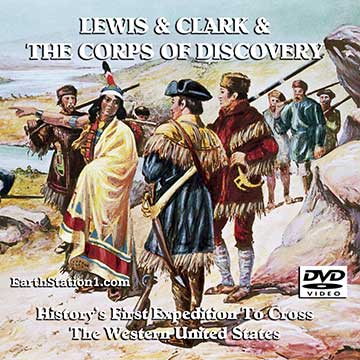
March 23, 1806: The Exploration Of North
America: The United States: The History Of The United States: The
Territorial Expansion of the United States (The Territorial
Evolution Of The United States): The Louisiana Purchase: The Lewis
And Clark Expedition (The Corps Of Discovery, The Corps Of
Discovery Expedition): The Corps Of Discovery: -- Lewis And Clark
and their "Corps of Discovery" explorers, after having
traveled through the Louisiana Purchase and reaching the Pacific
Ocean, begin their arduous journey home. The Lewis And Clark
Expedition from May 1804 to September 1806, also known as the
Corps of Discovery Expedition, was the first American expedition
to cross what is now the western portion of the United States. It
began near St. Louis, made its way westward, and passed through
the continental divide to reach the Pacific coast. The Corps of
Discovery comprised a selected group of U.S. Army volunteers under
the command of Captain Meriwether Lewis and his close friend,
Second Lieutenant William Clark. The Louisiana Purchase was the
acquisition of the Louisiana territory (828,000 square miles) by
the United States from France in 1803. The U.S. paid 50M francs
and a cancellation of debts worth 18M francs for a total of 68M
francs (15M USD, equivalent to 300M USD in 2016). The Louisiana
Purchase territory contained land that forms Arkansas, Missouri,
Iowa, Oklahoma, Kansas, and Nebraska; the portion of Minnesota
west of the Mississippi River; a large portion of North Dakota; a
large portion of South Dakota; the northeastern section of New
Mexico; the northern portion of Texas; the area of Montana,
Wyoming, and Colorado east of the Continental Divide; and
Louisiana west of the Mississippi River (plus New Orleans). Its
non-native population was around 60,000 inhabitants, of whom half
were African slaves. The Corps of Discovery was a
specially-established unit of the United States Army created from
a select group of volunteers which formed the nucleus of the Lewis
And Clark Expedition. Commissioned by President Thomas Jefferson,
the Corps' objectives were both scientific and commercial: to
study the area's plants, animal life, and geography, and to learn
how the Louisiana Purchase could be exploited economically. On
Sale @ 15% Off Discount Till Midnight PT!
https://store.earthstation1.com/lewis-amp-clark-amp-the-corps-of-discovery-dvd-mp4-usb-driv4.html
Today's
EarthStation1.com 15% Off Commemorative Memorial Title: Going
Hollywood: The War Years U.S. WWII Cinema DVD Download USB Drive
Today, March 23, 2026
March 23, 190? (No birth certificate;
1905, 1906 or 1908; Joan Crawford claimed 1908]: #BOTD: #HBD! Joan
Crawford, American movie star actress (d. May 10, 1977) is #born
Lucille Fay LeSueur in San Antonio, Texas. Starting as a dancer in
traveling theatrical companies before debuting on Broadway,
Crawford was signed to a motion picture contract by
Metro-Goldwyn-Mayer in 1925. Initially frustrated by the size and
quality of her parts, Crawford began a campaign of self-publicity
and became nationally known as a flapper by the end of the 1920s.
In the 1930s, Crawford's fame rivaled MGM colleagues Norma Shearer
and Greta Garbo. Crawford often played hardworking young women who
find romance and financial success. These "rags-to-riches"
stories were well received by Depression-era audiences and were
popular with women. Crawford became one of Hollywood's most
prominent movie stars and one of the highest paid women in the
United States, but her films began losing money and by the end of
the 1930s she was labeled "box office poison". After an
absence of nearly two years from the screen, Crawford staged a
comeback by starring in Mildred Pierce (1945), for which she won
the Academy Award for Best Actress. In 1955, she became involved
with the Pepsi-Cola Company, through her marriage to company
president Alfred Steele. After his death in 1959, Crawford was
elected to fill his vacancy on the board of directors but was
forcibly retired in 1973. She continued acting in film and
television regularly through the 1960s, when her performances
became fewer; after the release of the horror film Trog in 1970,
Crawford retired from the screen. Following a public appearance in
1974, after which unflattering photographs were published,
Crawford withdrew from public life. She became more and more
reclusive until her death in 1977. Crawford married four times.
Her first three marriages ended in divorce; the last ended with
the death of husband Al Steele. She adopted five children, one of
whom was reclaimed by his birth mother. Crawford's relationships
with her two older children, Christina and Christopher, were
acrimonious. Crawford disinherited the two and, after Crawford's
death, Christina wrote a "tell-all" memoir called Mommie
Dearest. Published in 1978, it attracted much controversy for its
portrayal of Crawford as an unbalanced and alcoholic mother. Some
family friends denounced it as fiction, with others corroborating
it. It was turned into a 1981 film of the same name starring Faye
Dunaway. Joan Crawford died at her apartment in Lenox Hill, New
York City, of a myocardial infarction (heart attack). A funeral
was held at Campbell Funeral Home, New York, on May 13, 1977, aged
69-73. In her will, which was signed on October 28, 1976, Crawford
bequeathed to her two youngest children, Cindy and Cathy, 77,500
USD each from her 2M USD estate. She explicitly disinherited the
two eldest, Christina and Christopher: "It is my intention to
make no provision herein for my son, Christopher, or my daughter,
Christina, for reasons which are well known to them." Both of
them challenged the will and received a 55K USD settlement. She
also bequeathed nothing to her niece, Joan Lowe (1933-1999; born
Joan Crawford LeSueur, the only child of her estranged brother,
Hal). Crawford left money to her favorite charities: the USO of
New York, the Motion Picture & Television Country House and
Hospital, the American Cancer Society, the Muscular Dystrophy
Association, the American Heart Association, and the Wiltwyck
School for Boys. During World War II, she was a member of American
Women's Voluntary Services. A memorial service was held for
Crawford at All Souls' Unitarian Church on Lexington Avenue in New
York on May 16, 1977. In attendance were long-time friend Myrna
Loy and co-stars Geraldine Brooks and Cliff Robertson, who gave
eulogies; Pearl Bailey sang "He'll Understand". Another
memorial service, organized by George Cukor, was held on June 24
in the Samuel Goldwyn Theater at the Academy Of Motion Picture
Arts And Sciences in Beverly Hills, California. Crawford was
cremated, and her ashes placed in a crypt with her fourth and
final husband, Alfred Steele, in Ferncliff Cemetery, Hartsdale,
New York. On Sale @ 15% Off Discount Till Midnight PT!
https://store.earthstation1.com/going-hollywood-the-war-years-us-wwii-cinema-dvd-download-usb-drive.html
Today's
EarthStation1.com 15% Off Commemorative Memorial Title: The
Germans In World War II Complete TV Series DVD, Download, USB
Today, March 23, 2026
March 23, 1905: #BOTD: #HBD! Lale
Andersen, German chanteuse (from chanson: in general any
lyric-driven French song, usually polyphonic and secular; a female
singer of chansons is a chanteuse) singer-songwriter and actress
(d. August 29, 1972) is #born in Lehe (part of modern Bremerhaven
in Bremen, Germany) and baptized Elisabeth Carlotta Helena Berta
Bunnenberg, but known informally as 'Liese-Lotte', a diminutive of
her first two names, to friends and family; this continued after
her first marriage when she was known as 'Liselotte Wilke'. She is
best known for her interpretation of the song Lili Marleen in
1939, which by 1941 transcended the conflict to become World War
II's biggest international hit. Popular with both the Axis and the
Allies, Andersen's original recording spawned versions, by the end
of the War, in most of the major languages of Europe, and by some
of the most popular artists in their respective countries. In
1922, aged 17, she married German Impressionist painter Paul Ernst
Wilke (1894-1971). They had three children: Bjorn, Carmen-Litta,
and Michael Wilke (1929-2017) the youngest of whom also enjoyed a
career in the German music industry. Shortly after the birth of
their last child, the marriage broke up. Leaving the children in
the care of her siblings Thekla and Helmut, Andersen went to
Berlin in October 1929, where she reportedly studied acting at the
Schauspielschule at the Deutsches Theater. In 1931, her marriage
ended in divorce. Around this time, she began appearing on stage
in various cabarets in Berlin. From 1933 to 1937, she performed at
the Schauspielhaus in Zurich, where she also met Rolf Liebermann,
who would remain a close friend for the rest of her life. In 1938,
she was in Munich at the cabaret Simpl, and soon afterwards joined
the prestigious Kabarett der Komiker (Comedians' Cabaret) in
Berlin. While at the Kabarett der Komiker, she met Norbert
Schultze, who had composed the music for "Lili Marleen".
Andersen recorded the song in 1939, but it would only become a hit
when the Soldatensender Belgrad (Belgrade Soldier's Radio), the
radio station of the German armed forces in occupied Yugoslavia,
began broadcasting it in 1941. "Lili Marleen" quickly
became immensely popular with German soldiers at the front. The
transmitter of the radio station at Belgrade, was powerful enough
to be received all over Europe and the Mediterranean, and the song
soon became popular with the Allied troops as well. Andersen was
awarded a gold disc for over one million sales of "Lili
Marleen" [His Masters Voice - EG 6993]. It is thought that
she was awarded her copy after the end of World War II. A copy of
this particular gold disc owned by the "His Masters Voice"
record company was discarded during the renovation of their
flagship store on Oxford Street, London, during the 1960s where,
hitherto, it had been on display. However, the disc was recovered
and is now in a private collection. Nazi officials did not approve
of the song and Joseph Goebbels prohibited it from being played on
the radio. Andersen was not allowed to perform in public for nine
months, not just because of the song but because of her friendship
with Rolf Liebermann and other Jewish artists she had met in
Zurich. In desperation, she reportedly attempted suicide. Andersen
was so popular, however, that the Nazi government allowed her to
perform again, albeit subject to several conditions, one of which
was she would not sing "Lili Marleen". Goebbels did
order her to make a new "military" version of the song
(with a significant drum) which was recorded in June 1942. In the
remaining war years, Andersen had one minor appearance in a
propaganda movie and was made to sing several propaganda songs in
English. Shortly before the end of the war, Andersen retired to
Langeoog, a small island off the North Sea coast of Germany. After
the war, Andersen all but disappeared as a singer. In 1949, she
married Swiss composer Artur Beul. In 1952 she made a comeback
with the song "Die blaue Nacht Am Hafen" (The Blue Night
At The Harbor) , which she had written the lyrics for herself. In
1959, she had another hit "Ein Schiff Wird Kommen..." (A
Ship Is Coming), a cover version of "Never on Sunday",
the title song from the movie of the same name, originally sung in
Greek by Melina Mercouri. Each song won her a gold album in
Germany. In 1961, she participated as the representative of
Germany in the Eurovision Song Contest with the song "Einmal
Sehen Wir Uns Wieder" (I'll See You Again Sometime) , which
only reached 13th place with three points. Fifty-six years old at
the time, for over 45 years, she held the record of the eldest
participant at Eurovision - surpassed only in 2008 by the
75-year-old Croatian entertainer 75 Cents. Throughout the 1960s,
she toured Europe, the United States and Canada, until her
farewell tour Goodbye Memories in 1967. Two years later, she
published a book Wie werde ich Haifisch? - Ein heiterer Ratgeber
fur alle, die Schlager singen, texten oder komponieren wollen (How
do I become a shark? - A cheerful companion for all who want to
sing hit songs, write lyrics, or compose music), and in 1972,
shortly before her death, her autobiography Der Himmel hat viele
Farben (The Sky Has Many Colours) appeared and topped the
bestselling list of the German magazine Der Spiegel. Lale Andersen
died of liver cancer in Vienna, Austria, aged 67. She was cremated
at Feuerhalle Simmering crematorium in Vienna, and her ashes are
buried in Dunenfriedhof (i.e. Sand Dunes Cemetery), on Langeoog
(German: "Long Island"), a municipality in the district
of Wittmund in Lower Saxony, Germany, and one of the seven
inhabited East Frisian Islands at the edge of the Lower Saxon
Wadden Sea in the southern North Sea, located between Baltrum
Island (west), and Spiekeroog (east). On Sale @ 15% Off Discount
Till Midnight PT!
https://store.earthstation1.com/the-germans-in-world-war-ii-dvd-3-disc-6-part-tv-seri36.html
Today's
EarthStation1.com 15% Off Commemorative Memorial Title: T.R.: The
Life Of Theodore Roosevelt DVD, Video Download, USB Drive
Today, March 23, 2026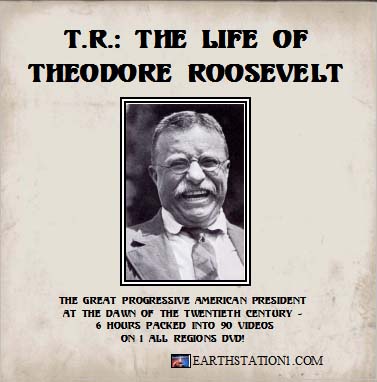
March 23, 1909: Africa: African
Expeditions: The Smithsonian-Roosevelt African Expedition: --
Theodore Roosevelt leaves New York for a post-presidency safari in
Africa. The trip is sponsored by the Smithsonian Institution and
National Geographic Society. The Smithsonian-Roosevelt African
Expedition was an expedition to Africa led by outgoing American
president Theodore Roosevelt and outfitted by the Smithsonian
Institution. Its purpose was to collect specimens for the
Smithsonian's new Natural History museum, now known as the
National Museum of Natural History. The expedition collected
around 11,400 animal specimens which took Smithsonian naturalists
eight years to catalog. Following the expedition, Roosevelt
chronicled it in his book African Game Trails. On Sale @ 15% Off
Discount Till Midnight PT!
https://store.earthstation1.com/tr-the-life-of-theodore-roosevelt-dvd-2-disc-se2.html
Today's
EarthStation1.com 15% Off Commemorative Memorial Title: Akira
Kurosawa (1979) Film Director Documentary DVD, Download, USB
Today, March 23, 2026
March 23, 1910: #BOTD: #HBD! Akira
Kurosawa, Japanese film director, producer, and screenwriter (d.
September 6, 1998) is #born Kurosawa Akira in Oimachi in the Omori
district of Tokyo, Japan. Regarded as one of the most important
and influential filmmakers in the history of cinema, he directed
30 films in a career spanning 57 years. Following a brief stint as
a painter, a talent which helped him throughout his film career,
he spent years of working on numerous films as an assistant
director and scriptwriter. He made his debut as a director during
World War II with the popular action film Sanshiro Sugata (a.k.a.
Judo Saga). After the war, the critically acclaimed Drunken Angel
(1948), in which Kurosawa cast then-unknown actor Toshiro Mifune
in a starring role, cemented the director' reputation as one of
the most important young filmmakers in Japan. The two men would go
on to collaborate on another 15 films. Rashomon, which premiered
in Tokyo, became the surprise winner of the Golden Lion at the
1952 Venice Film Festival. The commercial and critical success of
that film opened up Western film markets for the first time to the
products of the Japanese film industry, which in turn led to
international recognition for other Japanese filmmakers.
Throughout the 1950s and early 1960s, Kurosawa directed
approximately a film a year, including a number of highly regarded
(and often adapted) films, such as Ikiru (1952), Seven Samurai
(1954) and Yojimbo (1961). After the 1960s, he became much less
prolific, though his later work: including his final two epics,
Kagemusha (1980) and Ran (1985): continued to win awards though
more often abroad than in Japan. In 1990, he accepted the Academy
Award for Lifetime Achievement. On Sale @ 15% Off Discount Till
Midnight PT!
https://store.earthstation1.com/akira-kurosawa-film-director-dvd.html
Today's
EarthStation1.com 15% Off Commemorative Memorial Title: He
Conquered Space: Wernher von Braun + Bonus Bio MP4 Download DVD
Today, March 23, 2026
March 23, 1912: #BOTD: #HBD! Wernher von
Braun, German-American physicist, aerospace engineer and space
architect (d. June 16, 1977) is #born in the small town of Wirsitz
in the Province of Posen, Kingdom of Prussia, German Empire
(modern Poland). Wernher Magnus Maximilian Freiherr von Braun was
the leading figure in the development of rocket technology in
Germany and in rocket technology and space science in the United
States. In his twenties and early thirties, von Braun worked in
Nazi Germany's rocket development program. After he joined the SS
he helped design and develop the V-2 rocket at Peenemunde, Germany
during World War II. Following the war, he was secretly moved to
the United States, along with about 1,600 other German scientists,
engineers, and technicians, as part of Operation Paperclip. He
worked for the United States Army on an intermediate-range
ballistic missile (IRBM) program and he developed the rockets that
launched the United States' first space satellite Explorer 1. His
group was assimilated into NASA, where he served as director of
the newly formed Marshall Space Flight Center and as the chief
architect of the Saturn V super heavy-lift launch vehicle that
propelled the Apollo spacecraft to the Moon. In 1975, von Braun
received the National Medal of Science. He advocated for a human
mission to Mars. Wernher Von Braun died of pancreatic cancer in
Alexandria, Virginia, at age 65. He is buried on Valley Road at
the Ivy Hill Cemetery in Alexandria. His gravestone cites Psalm
19:1: "The heavens declare the glory of God; and the
firmament sheweth his handywork". On Sale @ 15% Off Discount
Till Midnight PT!
https://store.earthstation1.com/he-conquered-space-wernher-von-braun-mp4-video-download-dv4.html
Today's
EarthStation1.com 15% Off Commemorative Memorial Title: Terry And
The Pirates 1940 15 Part Movie Serial DVD, MP4, USB Drive
Today, March 23, 2026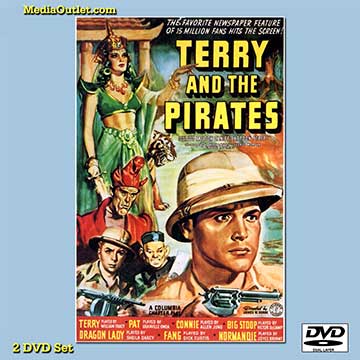
March 23, 1912: #BOTD: #HBD! Jeff York,
American film and television actor (d. October 11, 1995) is #born
Granville Owen Scofield in Los Angeles, California. He began his
career in the late 1930s using his given name, and he was also
sometimes credited as Jeff Yorke. During his early career, the
tall, dark-haired actor was a natural to play characters such as
Pat Ryan in the 1940 serial Terry and the Pirates and was given
the lead in the 1940 film Li'l Abner. However, he is perhaps most
remembered for his role as Bud Searcy in Disney's classic Old
Yeller and its 1963 sequel Savage Sam. Beverly Washburn played
Lisbeth Searcy, Bud's daughter. York also appeared in The Great
Locomotive Chase, Westward Ho, the Wagons!, and Johnny Tremain
which were all Walt Disney's productions. York served in the
United States Army during World War II. York attracted
considerable attention in the mid 1950s with his television
portrayal of Mike Fink, the flamboyant keelboat operator in two
episodes of Disney's hugely popular Davy Crockett miniseries in
the episodes "Davy Crockett's Keelboat Race" and "Davy
Crockett and the River Pirates." York was cast opposite Fess
Parker in the role. The first episode featured a memorable
boasting contest and a keelboat race, with Fink's boat named The
Gullywumper; in the second, Crockett and Fink join forces to fight
a band of river pirates who blame their depredations on local
Indians. He also starred as mountain man/fur trapper Joe Crane in
two different Disney series, The Saga of Andy Burnett, adapted
from the Stewart Edward White novel The Long Rifle and Zorro. In
addition, York was a guest star of The Lone Ranger (2 episodes),
Waterfront, Studio 57, Medic, Fireside Theater, You Are There (2
episodes), The Californians, Peter Gunn, Bronco, Lawman (2
episodes), Cheyenne, The Rifleman, Outlaws, Perry Mason (3
episodes), Daniel Boone, Zorro (3 episodes), and The Iron Horse.
He co-starred as "Reno McKee" with Roger Moore, Dorothy
Provine, and Ray Danton in the 1959 ABC/Warner Brothers western
television series, The Alaskans. Among his three appearances on
Perry Mason, York played roles as the defendant in two 1961
episodes: Pete Mallory in "The Case of the Difficult Detour,"
and Scott Cahill in "The Case of the Traveling Treasure."
In 1964 he played murderer and title character Ross Walker in "The
Case of the Arrogant Arsonist." On Sale @ 15% Off Discount
Till Midnight PT!
https://store.earthstation1.com/terry-and-the-pirates-dvd-1940-complete-movie-serial-2-19402.html
Today's
EarthStation1.com 15% Off Commemorative Memorial Title: World War
1 TV Series With Robert Ryan DVD, Video Download, USB Drive
Today, March 23, 2026
March 23, 1918: The European Civil War:
World War I: The First European War (The European Theater Of World
War I): The Western Front Of World War I: The German Spring
Offensive (Kaiserschlacht (German: "Kaiser's Battle"),
(The Ludendorff Offensive): Operation Michael (German: Unternehmen
Michael): The Battle Of St. Quentin: -- On the third day of the
German Spring Offensive, the 10th Battalion of the Royal West Kent
Regiment is annihilated with many of the men becoming prisoners of
war. Early on that Saturday morning, German troops broke through
the line in the British 14th Light Division sector on the Canal de
Saint-Quentin at Jussy. The British 54th Brigade were holding the
line directly to their south and were initially unaware of their
predicament, as they were unknowingly being outflanked and
surrounded. The 54th Brigade History records "the weather
still favoured the Germans. Fog was thick over the rivers, canals
and little valleys, so that he could bring up fresh masses of
troops unseen". In the confusion, Brigade HQ tried to
establish what was happening around Jussy and by late morning the
British were retreating in front of German troops who had crossed
the Crozat Canal at many points. All lines of defence had been
overrun and there was nothing left to stop the German advance;
during the day Aubigny, Brouchy, Cugny and Eaucourt fell.
Lieutenant Alfred Herring of the 6th Northamptonshire Battalion in
the 54th Brigade, despite having never been in battle before, led
a small and untried platoon as part of a counter-attack made by
three companies, against German troops who had captured the
Montagne Bridge on the Crozat Canal. The bridge was recaptured and
held for twelve hours before Herring was captured with the
remnants of his platoon. The remnants of the 1/1st Hertfordshire
Regiment were retreating across the southernmost edges of the 1916
Somme battlefield and by the morning of March 24 there were only
eight officers and around 450 men left. Ludendorff issued a
directive for the "continuation of the operations as soon as
the line Bapaume-Peronne-Ham had been reached: 17th Army will
vigorously attack in the direction Arras-St Pol, left wing on
Miraumont (7 km (4+1/2 mi) west of Bapaume). 2nd Army will take
Miraumont-Lihons (near Chaulnes) as direction of advance. 18th
Army, echeloned, will take Chaulnes-Noyon as direction of advance,
and will send strong forces via Ham". The 17th Army was to
roll-up British forces northwards and the 2nd Army was to attack
west along the Somme, towards the vital railway centre of Amiens.
The 18th Army was to head south-west, destroying French
reinforcements on their line of march and threatening the
approaches to Paris in the Second Battle of Picardy (2e Bataille
de Picardie). The advance had been costly and the German infantry
were beginning to show signs of exhaustion; transport difficulties
had emerged, supplies and much heavy artillery lagged behind the
advance. The 1918 German Spring Offensive, an all-out drive to win
the war, tbegan on March 21 with Operation Michael, launched from
the Hindenburg Line, in the vicinity of Saint-Quentin, France,
whose first three days became known as The Battle Of St. Quentin
March (21-23, 1918). Operation Michael's goal was to break through
the Allied (Entente) lines and advance in a north-westerly
direction to seize the Channel Ports, which supplied the British
Expeditionary Force (BEF), and to drive the BEF into the sea.
Following American entry into the war in April 1917, the Germans
decided that their only remaining chance of victory was to defeat
the Allies before the United States could ship soldiers across the
Atlantic and fully deploy its resources. Operation Michael was
launched from the Hindenburg Line (German: Siegfriedstellung,
"Siegfried Position"), a German defensive position in
the vicinity of Saint-Quentin, France. Its goal was to break
through the Allied (Entente) lines and advance in a north-westerly
direction to seize the Channel Ports, which supplied the British
Expeditionary Force (BEF) and to drive the BEF into the sea.
General Erich Ludendorff, the chief of the German General Staff,
began the battle with a five-hour artillery barrage, followed by a
rush of German troops. Two days later, Ludendorff adjusted his
plan and pushed for an offensive due west, along the whole of the
British front north of the River Somme. This was designed to first
separate the French and British Armies before continuing with the
original concept of pushing the BEF into the sea. The offensive
lasted until April 6 and resulted in the Germans gaining about 35
miles of territory. Allied and German casualty figures for both
battles approached 500,000. In July 1918, the Allies regained
their numerical advantage with the arrival of American troops. In
August, they used this and improved tactics to launch a
counteroffensive. The ensuing Hundred Days Offensive resulted in
the Germans losing all of the ground that they had taken in the
Spring Offensive, the collapse of the Hindenburg Line, and the
capitulation of Germany that November. On Sale @ 15% Off Discount
Till Midnight PT!
https://store.earthstation1.com/world-war-1-robert-ryan-4-dual-layer-dvds-26-episode-tv-se1426.html
Today's
EarthStation1.com 15% Off Commemorative Memorial Title: Benito
Mussolini Documentaries DVD, MP4 Video Download, USB Drive
Today, March 23, 2026
March 23, 1919: The Interwar Period (The
Interbellum, Between The Wars): The Road To War: Italian Fascism
(Italian: Fascismo Italiano) (Classical Rascism, Fascism): -- In
Milan, Italy, Benito Mussolini founds the fascist political
movement The Italian Fasci Of Combat (Italian: Fasci Italiani di
Combattimento), which until 1919 had been called Fasci of
Revolutionary Action (Italian: Fasci d'Azione Rivoluzionaria,
FAR), an Italian fascio organization also founded by Benito
Mussolini in 1914. Fascio i(Italian: "a bundle" or "a
sheaf", and figuratively "league" was used in the
late 19th century to refer to political groups of many different
(and sometimes opposing) orientations. A number of nationalist
fasci later evolved into the 20th century Fasci movement, which
became known as fascism. On March 23, 1919, the Fasci d'Azione
Rivoluzionaria was renamed in Fasci Italiani da Combattimento. In
1919, the Treaty Of Versailles resulted in Italy obtaining
Southern Tyrol, Trentino, Istria and Trieste from Austria.
However, Italy also wanted Fiume and the region of Dalmatia on the
Adriatic coast, hence they felt treated unfairly. In March 1919,
Mussolini set up the Fasci di Combattimenti (the fighting group),
which galvanised the support of the disgruntled, unemployed war
veterans. The Arditi, (The blackshirts, from the Italian
commandos) were angry about the problems in Italy. Mussolini
sympathised with them, claiming he shared their war experiences,
hence they joined the Fasci, eventually becoming the MVSN. In the
election of 1919, Mussolini and his party put forth a "decidedly
leftist" and anti-clerical program which called for higher
inheritance and capital-gains taxes and the ousting of the
monarchy. He also proposed an electoral alliance with the
socialists and other parties on the left, but was ignored over
concerns that he would be a liability with the voters. During the
election, Mussolini campaigned as the "Lenin of Italy"
in an effort to "out-socialist the socialists."
Mussolini and his party failed miserably against the socialists
who garnered forty times as many votes, an election so dismal that
even in Mussolini's home village of Predappio, not a single person
voted for him. In a mock funeral procession after the election,
members of Mussolini's former Italian Socialist Party, carried a
coffin that bore Mussolini's name, parading it past his apartment
to symbolize the end of his political career. Due to the
disastrous results in the November 1919 election, Mussolini
contemplated a name change for his Fascist party. By 1921,
Mussolini favored a plan to rename the PFR and the Fasci Italiani
di Combattimento to the "Fascist Labor Party" or
"National Labor Party" at the Third Fascist Congress in
Rome (November 7-10, 1921), in an effort to maintain his
reputation as being loyal to the left-wing tradition of supporting
trade unionism. Mussolini envisaged a more successful political
party if it was based on a fascist coalition of labor syndicates.
This alliance with socialists and labor was described as a sort of
"nationalist-leftist coalition government", but was
opposed by both more conservative fascist members and the
governing Italian Liberal Party of Giovanni Giolitti, who already
had decided to include the Fascists in their National Blocs. In
1921, this fascio would be transformed into the National Fascist
Party (Italian: Partito Nazionale Fascista, PNF). Mussolini
combined ideologies from a few different political parties.
Italian Fascism, also known simply as Fascism, is the original
fascist ideology as developed in Italy. The ideology is associated
with a series of political parties led by Benito Mussolin
throughout his life. On Sale @ 15% Off Discount Till Midnight PT!
https://store.earthstation1.com/benito-mussolini-dvd-wwii-documentaries.html
Today's
EarthStation1.com 15% Off Commemorative Memorial Title: Mein
Kampf: A Blueprint For The Age Of Chaos 1960 DVD, MP4, USB Drive
Today, March 23, 2026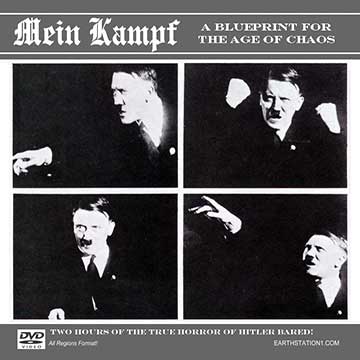
March 23, 1933: The Interwar Period (The
Interbellum, Between The Wars): The Road To War: Nazi Germany (The
German Reich, The Third Reich): Gleichschaltung (Nazification):
The Enabling Act Of 1933 (German: Ermachtigungsgesetz), officially
titled (Gesetz Zur Behebung Der Not Von Volk Und Reich, "Law
To Remedy The Distress Of People And Reich:): -- The Reichstag,
meeting at its new temporary quarters in the Kroll Opera House,
passes on the Enabling Act of 1933, making Adolf Hitler dictator
of Germany. Non-Nazi members of the Reichstag were surrounded and
threatened by members of SA and SS before and during the vote. The
Communists had already been repressed and were not able to vote,
and some Social Democrats were kept away as well. In the end, most
of those present voted for the act, except for the Social
Democrats, who voted against it. After it passed a Reichsrat vote
on March 24, it was signed by President Paul von Hindenburg that
day. The Enabling Act was a 1933 Weimar Constitution amendment
that gave the German Cabinet - in effect, Chancellor Adolf Hitler
- the power to enact laws without the involvement of the
Reichstag. The act stated that it was to last four years unless
renewed by the Reichstag, which occurred twice. The Enabling Act
gave Hitler plenary powers. It followed on the heels of the
Reichstag Fire Decree, which abolished most civil liberties and
transferred state powers to the Reich government. The combined
effect of the two laws was to transform Hitler's government into a
legal dictatorship. Gleichschaltung, or in English Coordination,
was in Nazi terminology the process of Nazification by which Adolf
Hitler and the Nazi Party successively established a system of
totalitarian control and coordination over all aspects of German
society, "from the economy and trade associations to the
media, culture and education". The apex of the Nazification
of Germany was in the resolutions approved during the Nuremberg
Rally of 1935, when the symbols of the Nazi Party and the State
were fused (see Flag of Germany) and German Jews were deprived of
their citizenship. On Sale @ 15% Off Discount Till Midnight PT!
https://store.earthstation1.com/mein-kampf-1960-dvd-adolf-hitler-third-reich-holoc1960.html
Today's
EarthStation1.com 15% Off Commemorative Memorial Title: Go For
Broke WWII Japanese-American 442nd Infantry DVD, MP4, USB Drive
Today, March 23, 2026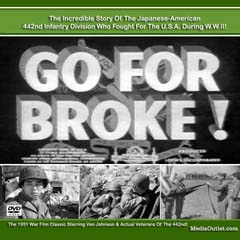
March 23, 1943: The European Civil War:
World War II: The Second European War (The European Theater Of
World War II): World War II: The Pacific War (The Asia-Pacific
War, The Pacific Theater Of World War II): The History Of Asian
Americans: The History Of Japanese Americans: The Internment Of
Japanese Americans: United States Armed Forces: The 442nd Infantry
Regiment: -- The 442nd Regimental Combat Team (RCT) of the United
States Army, who fought primarily in the European Theatre, in
particular Italy, southern France, and Germany, best known as the
most decorated in U.S. military history and as a fighting unit
composed almost entirely of second-generation American soldiers of
Japanese ancestry (Nisei) is organized as the The 442nd Infantry
Regiment (Japanese: Dai 442 Hohei Rentai) in response to the War
Department's call for volunteers to form the segregated Japanese
American army combat unit. More than 12,000 Nisei
(second-generation Japanese American) volunteers answered the
call. Ultimately 2,686 from Hawaii and 1,500 from mainland U.S.
internment camps assembled at Camp Shelby, Mississippi in April
1943 for a year of infantry training. Many of the soldiers from
the continental U.S. had families in internment camps while they
fought abroad. The unit's motto was "Go for Broke".
Created as the 442nd Regimental Combat Team (Japanese: Dai 442
Rentai Sento-dan) when it was activated 1 February 1943, the unit
quickly grew to its fighting complement of about 4,000 men by
April 1943, and an eventual total of about 10,000 men served in
the combined 100th Infantry Battalion and 442nd RCT. The combined
units earned, in less than two years, more than 4,000 Purple
Hearts and 4,000 Bronze Star Medals. The unit was awarded seven
Presidential Unit Citations (seven between 1944 and 1946, five
earned in one month). Twenty-one of its members were awarded the
Medal of Honor. In 2010, Congress approved the granting of the
Congressional Gold Medal to the 442nd Regimental Combat Team and
associated units who served during World War II, and in 2012, all
surviving members were made chevaliers of the French Legion
d'Honneur for their actions contributing to the liberation of
France and their heroic rescue of the Lost Battalion. Arriving in
the European Theatre, the 442nd Regimental Combat Team, with its
second and third infantry battalions, one artillery battalion and
associated HQ and service companies, was attached to the 34th
Infantry Division. On 11 June 1944, near Civitavecchia, Italy, the
100th Infantry Battalion, another all-Nisei fighting unit which
had already been in combat since September 1943, was transferred
from the 133rd Infantry Regiment to the 442nd Regimental Combat
Team. Because of its combat record, the 100th was allowed to keep
their original designation as the 100th Infantry Battalion. The
related 522nd Field Artillery Battalion liberated at least one of
the satellite labor camps of Dachau concentration camp and saved
survivors of a death march near Waakirchen. The 442nd RCT was
inactivated in 1946 and reactivated as a reserve battalion in
1947, garrisoned at Fort Shafter, Hawaii. The 442nd lives on
through the 100th Battalion/442nd Infantry Regiment, and is the
only current infantry formation in the Army Reserve. More
information about the current 100th Battalion/442nd Infantry
Regiment and its current alignment with the active 25th Infantry
Division, the reserve 9th Mission Support Command, and its combat
duty in the Vietnam War and the Iraq War can be found at 100th
Infantry Battalion (United States). The 100th/442nd's current
members carry on the honors and traditions of the historical unit.
In recognition of its storied combat record, the 100th/442nd was
also one of the last units allowed to use its individual shoulder
sleeve insignia. The 442nd Infantry Regiment was deactivated at
Honolulu, Hawaii on August 15, 1946. On Sale @ 15% Off Discount
Till Midnight PT!
https://store.earthstation1.com/go-for-broke-dvd-japaneseamerican-442nd-infantry-division-w442.html
Today's
EarthStation1.com 15% Off Commemorative Memorial Title: Soldiers:
A History Of Men In Battle TV Series + Bonus Title DVD MP4
Today, March 23, 2026
March 23, 1943: #BOTD: #HBD! Winston
Groom, American soldier, novelist, non-fiction writer and Vietnam
War veteran (d. September 17, 2020) is #born Winston Francis Groom
Jr. in Washington, D.C.. He is best known for his novel Forrest
Gump, published in 1986 and adapted to film in 1994, which won six
Academy Awards and became a cultural phenomenon. Groom wrote a
sequel, Gump and Co., published in 1995. He also wrote many
non-fiction works on diverse subjects including the American Civil
War and World War I. Upon his return from Vietnam, Groom worked as
a reporter for the Washington Star, a Washington, D. C. newspaper
covering the U.S. Department of Justice and U.S. federal courts.
Groom resigned and moved to New York to pursue a career in writing
novels. Groom's first novel was Better Times Than These which was
published in 1978. Better Times Than These was about a rifle
company in the Vietnam War whose patriotism and lives are
shattered. According to P.J O'Rourke, journalist and political
satirist and friend of Groom, Better Times Than These was "the
best novel written about the Vietnam War." His next novel As
Summers Die (1980) received better recognition. His book
Conversations with the Enemy (1982) follows an American Vietnam
War soldier who escapes from a POW camp and takes a plane back to
the United States only to be arrested fourteen years later for
desertion. Conversations with the Enemy was a Pulitzer Prize for
General Non-Fiction finalist in 1984. In 1985, Groom moved back to
Mobile, Alabama, where he began to work on the novel Forrest Gump.
The book had its origins in a story told to Groom by his elderly
father about a mentally disabled boy he had known as a child.
Groom began writing Forrest Gump the same day, and within six
weeks the novel was finished. Forrest Gump was published in 1986,
and was adapted into a 1994 film of the same name starring Tom
Hanks in the title role of Forrest Gump. The film propelled the
novel to best-seller status, and it sold 1.7 million copies
worldwide. However, Paramount Pictures utilized Hollywood
accounting to deflate profitability numbers of the film and Groom
received no payment for his 3% profit share in it. In November
2011, Groom introduced his latest history book, Kearny's March:
The Epic Creation of the American West, 1846-1847. Groom describes
how Brigadier General Stephen W. Kearny's quest for westward
adventure coincides with the expansionist desires of the U.S.
President, James K. Polk. Anchored in mid-summer 1846, the context
for both the adventures and expansionism is the Texas Annexation,
the Mexican-American War, and the backdrop to the American Civil
War. Groom weaves into Kearny's March mountain man Kit Carson,
Brigham Young and his Mormon followers, and members of the Donner
party. In 2016, El Paso, Groom's first novel in nearly 20 years,
was published. At the time of his death in 2020 Groom was waiting
for the publication of "The Patriots" a biography of
John Adams, Alexander Hamilton, and Thomas Jefferson. Groom was
married three times, and was divorced twice. He had one daughter,
and three stepchildren. Groom, who was 6 feet 6 inches tall, lived
in Alabama, and died from a suspected heart attack at his home in
Fairhope at age 77. On Sale @ 15% Off Discount Till Midnight PT!
https://store.earthstation1.com/soldiers-a-history-of-men-in-battle-4-dvds-all-13-sh413.html
Today's
EarthStation1.com 15% Off Commemorative Memorial Title: WABC Radio
Airchecks MP3 Collection 1960s-1980s DVD, MP3 Download, USB
Today, March 23, 2026
March 23, 1953: #BOTD: #HBD! Chaka Khan,
African American singer, songwriter and beauty is #born Yvette
Marie Stevens into an artistic, bohemian household in Chicago,
Illinois. Chaka Khan (Yoruban: Chaka "Woman of Fire",
Khan "Ruler"), has a career which spans nearly five
decades, beginning in the 1970s as the lead vocalist of the funk
band Rufus. Khan received public attention for her vocals and
image. Known as the "Queen of Funk", Khan was the first
R & B artist to have a crossover hit featuring a rapper, with
"I Feel for You" in 1984. More of Khan's hits include
"Through The Fire" and a 1986 collaboration with Steve
Winwood that produced a number-one hit on the Billboard Hot 100,
"Higher Love." Khan has won ten Grammy Awards and has
sold an estimated 70 million records worldwide. In the course of
her solo career, Khan has achieved three gold singles, three gold
albums and one platinum album with I Feel for You. With Rufus, she
achieved four gold singles, four gold albums, and two platinum
albums. She has collaborated with Ry Cooder, Robert Palmer, Ray
Charles, Quincy Jones, Guru, Chicago, De la Soul, Mary J. Blige,
among others. In December 2016, Billboard magazine ranked her as
the 65th most successful dance artist of all time. She was ranked
at number 17 in VH1's original list of the 100 Greatest Women of
Rock & Roll. She has been nominated for induction into The
Rock And Roll Hall Of Fame twice; she was first nominated as
member of Rufus in 2011. On Sale @ 15% Off Discount Till Midnight
PT!
https://store.earthstation1.com/wabc-musicradio-shows-mp3-dvd-60s80s-am-360807775.html
Today's
EarthStation1.com 15% Off Commemorative Memorial Title: Tibet
History & The Dalai Lama Documentaries DVD, MP4, USB Drive
Today, March 23, 2026
March 23, 1959: Tibet: The History Of
Tibet: The Aftermath Of World War II: The Cold War: The Cold War
In Asia: The 1959 Tibetan Uprising (The 1959 Tibetan Armed
Rebellion, The 1959 Tibetan Anti-Riot movement, The 1959 Tibetan
Unrests, The 1959 Anti-Chinese Uprising In Tibet, The Lhasa
Uprising): The Dalai Lama's Escape From Tibet (The Dalai Lama's
Escape From China): -- The 1959 Tibetan Uprising ends as Chinese
security forces fully retake Tibet's capital city of Lhasa. The
1959 Tibetan Uprising (March 10-23, 1959) began when a revolt
against Chinese rule erupted in Lhasa, the capital of Tibet, which
had been under the effective control of the People's Republic of
China (PRC) since the Seventeen Point Agreement was reached in
1951. The anniversary of the uprising is observed by Tibetan
exiles as the ''Tibetan Uprising Day'' and Woman's Uprising Day.
The initial uprising occurred amid general Chinese-Tibetan
tensions and a context of confusion, because Tibetan protesters
feared that the Chinese government might arrest the 14th Dalai
Lama. The protests were also fueled by anti-Chinese sentiment and
separatism. At first, the uprising mostly consisted of peaceful
protests, but clashes quickly erupted and the Chinese People's
Liberation Army (PLA) eventually used force to quell the protests,
some of the protesters had captured arms. The last stages of the
uprising included heavy fighting, with high civilian and military
losses. On March 17, 1959, Tenzin Gyatso, the 14th Dalai Lama, a
title given to the extant spiritual leader of the Tibetan people,
flees Tibet for India. At the outset of the 1959 Tibetan uprising
of Tibetans against the effective control of their country by the
People's Republic Of China, the Dalai Lama and his retinue,
fearing for their lives, fled Tibet with the help of the CIA's
Special Activities Division. They crossed into India on March
30-31, 1959, reaching Tezpur in Assam on April 18. Some time later
he set up the Government of Tibet in Exile in Dharamshala, India,
which is often referred to as "Little Lhasa". After the
founding of the government in exile he re-established the
approximately 80,000 Tibetan refugees who followed him into exile
in agricultural settlements. He created a Tibetan educational
system in order to teach the Tibetan children the language,
history, religion, and culture. The Tibetan Institute of
Performing Arts was established in 1959 and the Central Institute
of Higher Tibetan Studies became the primary university for
Tibetans in India in 1967. He supported the refounding of 200
monasteries and nunneries in an attempt to preserve Tibetan
Buddhist teachings and the Tibetan way of life. Thousands of
Tibetans were killed during The 1959 Tibetan Uprising, but the
exact number of deaths is disputed. Earlier in 1956, armed
conflict between Tibetan guerillas and the PLA started in the Kham
and Amdo regions, which had been subjected to socialist reform.
The guerrilla warfare later spread to other areas of Tibet and
lasted through 1962. Some regard the Xunhua Incident (April 17-25,
1958), an uprising of Tibetan and Salar people against the rule of
Chinese Communist Party (CCP) in the Qinghai, China province
bordering Tibet, as a precursor of the Tibetan uprising. The
annual March 10 anniversary of the uprising is observed by exiled
Tibetans as Tibetan Uprising Day and Women's Uprising Day. On
January 19, 2009, The PRC-controlled legislature in the Tibet
Autonomous Region chose March 28 as the national anniversary of
Serfs Emancipation Day. American Tibetologist Warren W. Smith Jr.
describes the move as a "counter-propaganda" celebration
following the March 10, 2008 unrest in Tibet. Tibet, as it is
today, was first unified in the Seventh Century A.D., by King
Songsten Gampo and his successors. However, its history began in
127 B.C., with the formation of the Yarlung Dynasty. The People's
Liberation Army of the People's Republic of China initially
entered Tibet in 1949, defeating the small Tibetan army and
seizing half of the nation, marking a watershed moment in Tibet's
history. Repression, which included the destruction of holy
buildings and the arrest of monks and other community leaders,
rose substantially as resistance to the Chinese occupation grew,
particularly in Eastern Tibet. The Communist Chinese government
invaded Tibet in 1950, causing chaos and misery for Tibetans,
finally resulting in the fall of the Tibetan government and the
self-imposed exile of the Dalai Lama and 100,000 Tibetans in 1959.
Despite all the religious persecution, loss of their national
heritage, and frequent violations of their human rights, Tibetans
continue to raise their voices in unison, asking for independence.
Tibet is still considered a sovereign state under international
law. Tibet's sovereignty has not been transferred to China as a
result of China's armed invasion and ongoing occupation by the
People's Liberation Army (P.L.A.). All who continue to support
this cause believe, that someday, Tibet will achieve the
independence it so dearly desires and deserves. On Sale @ 15% Off
Discount Till Midnight PT!
https://store.earthstation1.com/tibet-documentaries-2-dvd-se2.html
Today's
EarthStation1.com 15% Off Commemorative Memorial Title: Outer
Space Films 2: Project Gemini DVD, Video Download, USB Drive
Today, March 23, 2026
March 23, 1965: Outer Space Firsts:
Rocket Launches: The History Of Spaceflight: The Aftermath Of
World War II: The Cold War: The Space Age: The Space Age: Space
Programs Of The United States: Human Spaceflight Programs: Project
Gemini: Gemini 3: -- NASA launches Gemini 3, the first two-man
space flight and the first flight to perform an orbital maneuver,
at 14:24:00 UTC atop a Gemini-Titan II rocket (Titan II Gemini
Launch Vehicle [GLV]) from Cape Kennedy Launch Complex 19 (LC-19)
on the first manned mission in NASA's Gemini program, the second
American manned space program. That day, astronauts Gus Grissom
and John Young flew three low Earth orbits in their spacecraft,
which they nicknamed Molly Brown. This was the ninth manned US
spaceflight (including two X-15 flights over 100 kilometers), and
the 17th world human spaceflight including eight Soviet flights.
It was also the final manned flight controlled from Cape Kennedy
Air Force Station in Florida, before mission control functions
were shifted to a new control center located at the newly opened
Manned Spacecraft Center in Houston, Texas. On March 23, 1965, at
15:57:00 UTC, at the end of the first orbit, over Corpus Christi,
Texas, a 1-minute 14 second burn of the Orbit Attitude and
Maneuvering System (OAMS) engines gave a reverse delta-V of 15.5
meters per second (51 ft/s), which changed the orbit from 161.2 by
224.2 kilometers (87.0 by 121.1 nautical miles) (with a period of
88.3 minutes), to an orbit of 158 by 169 kilometers (85 by 91 nmi)
(period of 87.8 minutes). This was the first orbital maneuver made
by any crewed spacecraft. It splashed down 4 hours, 52 minutes, 31
seconds later in the North Atlantic Ocean north east of the the
Turks and Caicos Islands in the The West Indies, and was recovered
by the USS Intrepid (the current museum ship of The Intrepid Sea,
Air & Space Museum Complex in New York City). On Sale @ 15%
Off Discount Till Midnight PT!
https://store.earthstation1.com/outer-space-films-2-project-gemini-pushing-the-envelope-dv2.html
Today's
EarthStation1.com 15% Off Commemorative Memorial Title: Color Us
Black! The 1968 Howard University Protest MP4 Download DVD
Today, March 23, 2026
March 23, 1968: Civil Rights Movements:
The American Civil Rights Movement (1954-1968): Black Power: The
Black Power Movement (The Black Liberation Movement): The
Counterculture Of The 1960s: Student Rights: Student Rights In
Higher Education: Student Activism (Campus Activism): Student
Protest (Campus Protest): The Protests Of 1968: The 1968 Howard
University Protest (March 19-23, 1968): -- Howard students succeed
at creating a "Black university" as the university gives
in to most of the students' demands; the protesters both of Howard
University's Charter Day celebration and the later occupation of
the Universiy would not be punished, and the university
established a student judiciary committee to weigh in on future
disciplinary issues. Courses on Black culture and history were
added to the school's curriculum. However, President James Nabrit,
who was away in Puerto Rico and did not return during the
protests, declined to resign based on the idea that he was set to
retire soon anyway. Howard quickly created a Department of African
American Studies. Black-centric courses were added to curricula in
the history, political science, and economics departments; Black
literature, poetry and jazz also became the focus on new classes.
Howard also began offering doctoral degrees in African studies in
1969. Nabrit was succeeded as president by James Cheeks, Ph.D.,
who previously led Shaw University. In addition to presiding over
new Afro-American studies offerings at Howard, Cheeks also vastly
expanded the school's enrollment, faculty, graduate offerings and
budget. Even so, Cheeks would eventually become the target of
student protests as well. The 1968 Howard University Protest began
on March 19, 1968 when about 1,000 students held a rally in front
of Douglass Hall. From there, a group of students seized the
Administration Building to conduct a sit-in at President Nabrit's
office until their demands were at least addressed, if not met. As
two of the conditions for vacating the building, the students
insisted on changes in the discipline policy and that courses be
offered in African American history. The activists wanted Nabrit's
resignation; a judiciary system for student discipline; an
emphasis on African American history and culture in the
curriculum, and the dropping of charges against 39 students
inspired by the above issues who had made a protest three weeks
earlier at Howard's centennial Charter Day celebration. Most
important, they simply wanted negotiations and to be heard. That
was unusual at most institutions at the time, and particularly at
Howard: "They would not dignify us with a response,"
Adrienne Manns Israel said. "Our demand is an answer - we
want you to say publicly what you think about these issues. And
[Nabrit] never would." As they entered the building, it
turned out they had more support than they thought. "When we
went in, we thought it would be the usual group... that we would
be there, and it would be one more instance when they came and
dragged us out," Anthony Gittens said. "We turned around
as we were walking into the building, and first there were scores,
and then the word got out around campus about what was happening,
and there were hundreds of students who joined the protest and
took over the entire building." The 1968 Howard University
Protest (March 19-23, 1968) was a five-day sit-in seizing of the
administration building of Howard University, intially to call for
amnesty for the protestors against Howard president James Nabrit
Jr. at the March 2, 1968 Howard Charter Day celebration, and for
student involvement in student disciplinary decisions, but the
goals of the protest soon expanded into an agenda aimed at making
Howard more Black-centric and more relevant to the larger Black
community. The students demanded Nabrit's resignation, called for
African American history courses to be added to the curriculum and
urged the university to include student involvement in the larger
Washington, D.C. community as part of their studies. The protest
shut down most of the campus for several days as students refused
to budge on their demands. Tensions had been building up on
Howard's campus for some time before the mass protests of March
1968. The previous year, students had yet to gain protested
compulsory ROTC participation for students; many of them felt that
the program was channeling Howard students into the military and
the Vietnam War. Additionally, much of the student discontment at
the time was aimed at university president James Nabrit Jr. Before
leading Howard, Nabrit had been a prominent civil rights attorney
who worked with Thurgood Marshall and successfully argued an
anti-segregation case -a companion case to Brown v. Board of
Education - in front of the U.S. Supreme Court. As president of
Howard starting in 1960, Nabrit embraced Howard's reputation at
the time as a "Black Harvard" and reportedly wanted to
admit more white students. The student body, meanwhile, complained
that there was little Black-created or Black-focused content in
the school's curriculum. "Howard is not a Black university,"
many students complained. Students were also upset over inadequate
living conditions, and some wanted Nabrit to step down. During the
1968 Charter Day celebration, marking the 101st anniversary of the
school's founding on March 2, 1867, about three dozen students
disrupted the ceremony and again called for Nabrit to step down.
When the university sought to punish the Charter Day protesters,
this set off a much larger protest that became the largest in the
school's history. Students at mostly Howard University vowed to
continue their rebellion until radical changes are made in the
federally supported university's administration. The university
was shut donw on March 20th when the demonstrators occupied its
administration building in the center of the school's campus.
School officials, locked out of their own offices, appeared to be
waiting out the students' protest in hopes the 2-day protest would
fizzle. The protests drew support from the local community and
beyond. Over 2,000 students participated in the sit-in of the
university's administrative office, taking shifts occupying the
building. During the four-day protest, members of the faculty
served as liaisons between students and administrators, and some
professors even held lectures outside of the occupied building so
that student protesters would not fall behind in their classes.
Another 3,000 students barricaded themselves inside of their
dorms, concerned that police might be called to battle the
protests. Dozens of local D.C. restaurants and stores donated food
and supplies to the Howard dorms. A pivotal leader of the national
Black Power movement Stokely Carmichael, who'd been a recent
Howard graduate at the time and was also a former leader of the
Student Nonviolent Coordinating Committee, came to address the
protesters thought it's not known what exactly he said. The
takeover has inspired future student protests at Howard and other
campuses .Partially inspired by the Howard protests, students at
Columbia University protested in April, taking over several campus
buildings. Columbia's status as an Ivy League and predominantly
white institution drew significantly more attention than the
Howard occupation. So did the fact that the Columbia uprising
turned violent - students held a dean hostage, and police
eventually arrested hundreds of students, many of whom suffered
injuries in the process. Meanwhile, Howard students were not done
protesting. In 1986, they again occupied the school's
administrative building when Cheeks appointed Republican National
Committee chair Lee Atwater to the school's board of trustees.
Atwater had been the main architect of the Republican's "Southern
strategy," an intentional effort to appeal to southern white
racist fears to gain votes. Atwater used this strategy to help
elect former Presidents Ronald Reagan and George H.W. Bush - the
racist "Willie Horton" ad was a major feature of Bush's
winning campaign against Democratic candidate Michael Dukakis.
Occupying students forced Atwater to resign from the Howard
position, and Cheeks soon left the school as well. Drawing from
Howard's long history of protest, students - led by a group titled
HU Resist - staged the longest occupation in the school's history.
This time, the students presented officials with a long list of
demands for reform on campus, covering every aspect of Howard from
housing and tuition to increased mental health service and
stronger sexual assault prevention measures. As has been the case
before, Howard's student protesters were largely successful, with
administrators meeting most of their demands. Since then, Howard
students have marched from campus to the White House after the
killing of George Floyd and hosted a national conference last
October titled "From Protest to Policy: The Pursuit of Racial
Justice." After nearly 100 years of activism on campus and
across Washington, D.C., Howard students show little sign of
dialing back their activism. On Sale @ 15% Off Discount Till
Midnight PT!
https://store.earthstation1.com/color-us-black-the-1968-howard-university-protest-mp4-downloa19684.html
Today's
EarthStation1.com 15% Off Commemorative Memorial Title: War And
Peace In The Nuclear Age TV Series DVD, Download, USB Drive
Today, March 23, 2026
March 23, 1983: Missile Defense: Missile
Defense Systems: The Strategic Defense Initiative (SDI) (The Star
Wars Program): -- President Ronald Reagan makes his initial public
proposal to develop technology to intercept enemy missiles. The
Strategic Defense Initiative (SDI) was a proposed missile defense
system intended to protect the United States from attack by
ballistic strategic nuclear weapons (intercontinental ballistic
missiles and submarine-launched ballistic missiles). Reagan was a
vocal critic of the doctrine of mutual assured destruction (MAD),
which he described as a "suicide pact", and he called
upon the scientists and engineers of the United States to develop
a system that would render nuclear weapons obsolete. SDI was
nicknamed by the media as "Star Wars", after the popular
1977 film by George Lucas. The Strategic Defense Initiative
Organization (SDIO) was set up in 1984 within the United States
Department of Defense to oversee development. A wide array of
advanced weapon concepts, including lasers, particle beam weapons
and ground- and space-based missile systems were studied, along
with various sensor, command and control, and high-performance
computer systems that would be needed to control a system
consisting of hundreds of combat centers and satellites spanning
the entire globe. A number of these concepts were tested through
the late 1980s, and follow-on efforts and spin-offs continue to
this day. In 1987, the American Physical Society concluded that
the technologies being considered were decades away from being
ready for use, and at least another decade of research was
required to know whether such a system was even possible. After
the publication of the APS report, SDIs budget was repeatedly cut.
By the late 1980s, the effort had been re-focused on the
"Brilliant Pebbles" concept using small orbiting
missiles not unlike a conventional air-to-air missile, which was
expected to be much less expensive to develop and deploy. In
recent years, Anti-ballistic Missiles (ABM), which were first
deployed by the Soviet Union in 1971, have become the method of
choice for the destruction of enemy missiles. On Sale @ 15% Off
Discount Till Midnight PT!
https://store.earthstation1.com/war-and-peace-in-the-nuclear-age-dvd-set-tv-series-7-disc7.html
Today's
EarthStation1.com 15% Off Commemorative Memorial Title: Heaven Man
Earth: Kowloon Walled City & Hong Kong Triads MP4 Or DVD
Today, March 23, 2026
March 23, 1993: Crime: Crime In China:
Organized Crime: Organized Crime Triads: Kowloon Walled City: --
The ungoverned, crime-ridden, densely populated de jure Chinese
enclave within the boundaries of Kowloon City, Hong Kong, begins
to be demolished, a process which will continue until April 1994.
Kowloon Walled City was an originally a Chinese military fort that
became an enclave after the New Territories were leased to the
United Kingdom by China in 1898. Its population increased
dramatically following the Japanese occupation of Hong Kong during
World War II. By 1990, the walled city contained 50,000 residents
within its 2.6-hectare (6.4-acre) borders. From the 1950s to the
1970s, it was controlled by local triads and had high rates of
prostitution, gambling, and drug abuse. In January 1987, the Hong
Kong government announced plans to demolish the walled city. After
an arduous eviction process, and the transfer of de jure
sovereignty of the enclave from China to Britain, demolition began
in March 1993 and was completed in April 1994. Kowloon Walled City
Park opened in December 1995 and occupies the area of the former
walled city. Some historical artefacts from the walled city,
including its yamen building and remnants of its southern gate,
have been preserved there. On Sale @ 15% Off Discount Till
Midnight PT!
https://store.earthstation1.com/heaven-man-earth-the-organized-crime-of-the-chinese-triads-dvd.html
Today's
EarthStation1.com 15% Off Commemorative Memorial Title: Russian
Right Stuff: Soviet Space Program TV Series DVD, Download, USB
Today, March 23, 2026
March 23, 2001: The History Of
Spaceflight: The Aftermath Of World War II: The Cold War: The
Space Age: The Soviet Space Program: Human Spaceflight Programs:
Space Stations: Mir (Russian: "Peace", "World"):
-- The Russian Mir space station is disposed of, breaking up in
the atmosphere before falling into the southern Pacific Ocean near
Fiji. Mir, meaning peace or world in Russian, was a space station
that operated in low Earth orbit from 1986 to 2001, operated by
the Soviet Union and later by Russia. Mir was the first modular
space station and was assembled in orbit from 1986 to 1996. It had
a greater mass than any previous spacecraft. At the time it was
the largest artificial satellite in orbit, succeeded by the
International Space Station after Mir's orbit decayed. The station
served as a microgravity research laboratory in which crews
conducted experiments in biology, human biology, physics,
astronomy, meteorology and spacecraft systems with a goal of
developing technologies required for permanent occupation of
space. Mir was the first continuously inhabited long-term research
station in orbit and held the record for the longest continuous
human presence in space at 3,644 days, until it was surpassed by
the ISS on 23 October 2010. It holds the record for the longest
single human spaceflight, with Valeri Polyakov spending 437 days
and 18 hours on the station between 1994 and 1995. Mir was
occupied for a total of twelve and a half years out of its
fifteen-year lifespan, having the capacity to support a resident
crew of three, or larger crews for short visits. On Sale @ 15% Off
Discount Till Midnight PT!
https://store.earthstation1.com/russian-right-stuff-dvd-set-space-program-secret-history-2-disc2.html
Today's
EarthStation1.com #OnThisDay Commemorative Memorial Title: The
Sandy Becker TV Kid Shows Collection DVD MP4 Download USB Drive
Today, March 23, 2026 March 23: National Tamale Day: -- Sweet
or savory, National Tamale Day on March 23rd celebrates a
traditional Mexican dish made from a cornmeal dough and filled
with a variety of meats, vegetables, or fruit. Traditional tamales
are made with a dough called masa. When making tamales, you spread
the dough on a corn husk or banana leaf before adding the
fillings. Then you wrap the leaves around the entire package and
steam it into a fragrant, mouthwatering meal. While they are
popular street food in South America and the southern United
States today, the tamale likely has its origins in Mesoamerica as
early as 8000 to 5000 B.C. Masa is made from nixtamalized
cornmeal. Nixtamalized corn has been soaked and cooked in an
alkaline solution such as limewater or hardwood ash to remove the
seed husk. Savory tamales consist of beans, rice, cheese, pork,
chicken, turkey, and various vegetables and seasonings.
Traditionally, people enjoy the tamale fresh from its steamy
package, unenhanced by salsa and crema. However, that isn't to say
that you shouldn't drizzle a little hot sauce or guacamole if you
choose. Dessert tamales satisfy sweet tooths of every kind. Think
fruity, caramel, and creamy steamed hand pies. Usually a smaller
version of the hearty, savory tamale, these dessert tamales
provide a little indulgence at the end of a meal. In 2015, Richard
Lambert, owner of Santa Barbara-based Tamales-To-Go, founded
National Tamales Day to celebrate the family's love of tamales and
his signature dish. They chose March 23rd to encourage the
enjoyment of tamales all year long and because the only food
competition on the calendar was Melba Toast.
https://store.earthstation1.com/sandy-becker-1950s60s-new-york-city-old-time-kid-show-195060.html
March 23: National Tamale Day: -- Sweet
or savory, National Tamale Day on March 23rd celebrates a
traditional Mexican dish made from a cornmeal dough and filled
with a variety of meats, vegetables, or fruit. Traditional tamales
are made with a dough called masa. When making tamales, you spread
the dough on a corn husk or banana leaf before adding the
fillings. Then you wrap the leaves around the entire package and
steam it into a fragrant, mouthwatering meal. While they are
popular street food in South America and the southern United
States today, the tamale likely has its origins in Mesoamerica as
early as 8000 to 5000 B.C. Masa is made from nixtamalized
cornmeal. Nixtamalized corn has been soaked and cooked in an
alkaline solution such as limewater or hardwood ash to remove the
seed husk. Savory tamales consist of beans, rice, cheese, pork,
chicken, turkey, and various vegetables and seasonings.
Traditionally, people enjoy the tamale fresh from its steamy
package, unenhanced by salsa and crema. However, that isn't to say
that you shouldn't drizzle a little hot sauce or guacamole if you
choose. Dessert tamales satisfy sweet tooths of every kind. Think
fruity, caramel, and creamy steamed hand pies. Usually a smaller
version of the hearty, savory tamale, these dessert tamales
provide a little indulgence at the end of a meal. In 2015, Richard
Lambert, owner of Santa Barbara-based Tamales-To-Go, founded
National Tamales Day to celebrate the family's love of tamales and
his signature dish. They chose March 23rd to encourage the
enjoyment of tamales all year long and because the only food
competition on the calendar was Melba Toast.
https://store.earthstation1.com/sandy-becker-1950s60s-new-york-city-old-time-kid-show-195060.html
Today's
EarthStation1.com #OnThisDay Commemorative Memorial Title:
Challenge Of The Yukon Old Time Radio Series MP3 Set DVD Download
USB
Today, March 23, 2026March 23: World Bear Day: -- A day that
advocates for the preservation of wild habitats to protect these
magnificent creatures and the delicate balance of nature they
represent. Show some love, along with tons of respect, for these
fluffy, strong animals who are so iconic - and also just enormous!
World Bear Day brings attention to how cool these mammals are, but
the day is also meant to raise awareness for the ways that their
habitats may be at risk and reminding people how they can help.
World Bear Day has been celebrated for more than three decades
since it was first established in 1992. Starting out small, this
day has grown in scope and popularity over the years as it shows
appreciation for these spectacular furry creatures. Other than
Australia and Antarctica, every continent has a bear that is
native to its lands. But with six of the eight species of bears on
the threatened or endangered list, bears face some difficult
circumstances. Because these are solitary animals that require a
great deal of space to live and hunt, the places where bears live
have been severely limited over the past several decades. Due to
the expansion of logging, agriculture and climate change, as well
as human encroachment, bear populations are declining. Celebrate
World Bear Day to show support and raise awareness about the needs
of these marvelous creatures!
https://store.earthstation1.com/challenge-of-the-yukon-mp3-dvd-complete-radio-broadcast3.html
Today's
EarthStation1.com #OnThisDay Commemorative Memorial Title: Great
Comet Crash: Shoemaker-Levy 9 Live + Doomsday Asteroid MP4 DVD
Today, March 23, 2026March 23: Near Miss Day: -- What would
you do if a huge asteroid was about to hit planet Earth? On March
23, 1989, an asteroid about the size of a mountain came very close
to colliding with the Earth. Thankfully, it was a near miss!
Otherwise, the effect of the collision would have been
devastating. People around the world celebrate this day to be
grateful that the asteroid didn't wipe us out! According to
scientists and astronomers, many meteoroids and asteroids have
passed by the Earth since 1989. However, the odds of an asteroid
hitting the Earth are not high. That's a relief! Asteroids are
rocks that were formed after the formation of our solar system -
they are the leftovers of a great process. Asclepius is an
asteroid with a diameter of 0.431 kilometers, comparable to the
size of a football field. On March 22, 1989, Asclepius passed by
the Earth at a distance of almost 500,000 miles. However,
scientists only discovered this after nine days. Many
geophysicists believe that the collision of Asclepius with the
Earth would have wreaked havoc, resulting in the release of energy
comparable to a 600 megaton atomic bomb! The reason this day has
great importance is that the Earth nearly escaped from an
apocalypse. We all got a second chance at life. This event changed
our perspective on cosmic influences - it made us realize that
humankind has absolutely no control over the universe. Since that
day, there have been advanced changes in space programs. Missions
were organized and space shuttles were sent to nearby planets to
study life on them. Near Miss Day also reminds us that asteroids
and meteors can lead to the extinction of the Earth and the human
race.
https://store.earthstation1.com/great-comet-crash-live-shoemakerlevy-9-jupiter-collisions-dvd-mp4-u94.html
Today's
EarthStation1.com #OnThisDay Commemorative Memorial Title: The
Life And Times Of Lord Mountbatten TV Series DVD, Download, USB
Today, March 23, 2026March 23, 1981: #DOTD: #RIP: Claude
Auchinleck, English field marshal, British Indian Army commander
who saw active service during World War I and World War II (b.
June 21, 1884) #dies at his home in Marrakesh, Morocco, aged 96.
Auchinleck is buried in Ben M'Sik European Cemetery, Casablanca,
in the Commonwealth War Graves Commission plot in the cemetery,
next to the grave of Raymond Steed who was the second youngest
non-civilian Commonwealth casualty of the Second World War. A
memorial plaque was erected in the crypt of St Paul's Cathedral. A
bronze statue of Auchinleck can be seen on Broad Street adjacent
to Auchinleck House, Five Ways, Birmingham, West Midlands,
England. Claude Auchinleck was born Claude John Eyre Auchinleck in
Aldershot, Hampshire, western South East England. Field Marshal
Sir Claude John Eyre Auchinleck, GCB, GCIE, CSI, DSO, OBE was a
career soldier who spent much of his military career in India,
where he rose to become Commander-In-Chief of the Indian Army by
early 1941. In July 1941 he was appointed Commander-In-Chief of
the Middle East theatre, but after initial successes the war in
North Africa turned against the British, and he was relieved of
the post in 1942 during the crucial Alamein Campaign. In June 1943
he was once more appointed Commander-In-Chief India, where his
support through the organisation of supply, maintenance and
training for Slim's Fourteenth Army played an important role in
its success. He served as Commander-In-Chief India until Partition
in 1947, when he assumed the role of Supreme Commander of all
British forces in India and Pakistan until late 1948.
https://store.earthstation1.com/life-and-times-of-lord-mountbatten-3-dvds-tv-series-all-12-pa312.html
Today's
EarthStation1.com #OnThisDay Commemorative Memorial Title:
Suspense! Old Time Radio Series DVD, MP3 Download, USB Flash Drive
Today, March 23, 2026March 23, 1964: #DOTD: #RIP: Peter Lorre,
Hungarian-American stage, screen and radio actor (b. June 26,
1904)# dies in Los Angeles from a stroke. His body was cremated
and his ashes were interred at the Hollywood Forever Cemetery in
Hollywood. Vincent Price read the eulogy at his funeral. Born
Laszlo Lowenstein to a Jewish family in the Hungarian town of
Rozsahegy in Lipto County (German: Rosenberg; Slovak: Ruzomberok,
now in Slovakia), Lorre began his stage career in Vienna before
moving to Germany where he worked first on the stage, then in film
in Berlin in the late 1920s and early 1930s. Lorre caused an
international sensation in the German film M (1931), directed by
Fritz Lang, in which he portrayed a serial killer who preys on
little girls. Beingf Jewish descent, Lorre left Germany when Adolf
Hitler came to power. His second English-language film, following
the multiple-language version of M (1931), was Alfred Hitchcock's
The Man Who Knew Too Much (1934) made in Great Britain. Eventually
settling in Hollywood, he later became a featured player in many
Hollywood crime and mystery films. In his initial American films,
Mad Love and Crime and Punishment (both 1935), he continued to
play murderers, but he was then cast playing Mr. Moto, the
Japanese detective, in a B-picture series. From 1941 to 1946, he
mainly worked for Warner Bros. His first film at Warner was The
Maltese Falcon (1941), the first of many films in which he
appeared alongside actors Humphrey Bogart and Sydney Greenstreet.
This was followed by Casablanca (1942), the second of the nine
films in which Lorre and Greenstreet appeared together. Lorre's
other films include Frank Capra's Arsenic and Old Lace (1944) and
Disney's 20,000 Leagues Under the Sea (1954). Frequently typecast
as a sinister foreigner, his later career was erratic. Lorre was
the first actor to play a James Bond villain as Le Chiffre in a TV
version of Casino Royale (1954). Some of his last roles were in
horror films directed by Roger Corman.
https://store.earthstation1.com/suspense-mp3-dvd-complete-old-time-radio-serie3.html
Today's
EarthStation1.com #OnThisDay Commemorative Memorial Title: The
History Of Jazz A Video Retrospective DVD, MP4 Download, USB Drive
Today, March 23, 2026March 23, 1967: #DOTD: #RIP: Pete
Johnson, African American jazz pianist who strongly influenced the
beginnings of rock and roll, one of the three greatest
boogie-woogie pianists (the other two being Albert Ammons and
Meade Lux Lewis) whose sudden prominence in the late 1930s helped
make boogie-woogie very popular, known for his technical
virtuosity and melodic creativity (b. March 25, 1904) #dies in
Meyer Hospital, Buffalo, New York, in March 1967, two days before
his 63rd birthday. He is buried at Forest Lawn cemetery in
Buffalo. Of the three great boogie-woogie pianists, Pet Johnson
was more comfortable in a band setting than Meade Lux Lewis, and
unlike Lewis or Albert Ammons, he could shine as an accompanist
without outshining his singing partner, a gift especially evident
in Joe Turner's "Roll 'Em, Pete". Pete Johnson was born
Kermit Holden Johnson in Kansas City, Missouri. He was raised by
his mother after his father deserted the family. Things got so bad
financially, Pete was placed in an orphanage when he was three. He
became so homesick, however, that he ran away and returned living
at home. By the age of 12, he sought out work to ease some of the
financial burden at home. He worked various jobs; in a factory, a
print shop, and as a shoe-shiner. He dropped out of school in the
fifth grade as a result of his efforts. Johnson began his musical
career in 1922 as a drummer in Kansas City. He began piano about
the same time he was learning the drums. His early piano practices
took place in a church, where he was working as a water boy for a
construction company. From 1926 to 1938, he worked as a pianist,
often working with Big Joe Turner. An encounter with record
producer John Hammond in 1936 led to an engagement at the Famous
Door in New York City. In 1938, Johnson and Turner appeared in the
From Spirituals to Swing concert at Carnegie Hall. After this show
the popularity of the boogie-woogie style was on the upswing.
Johnson worked locally and toured and recorded with Turner, Meade
Lux Lewis, and Albert Ammons during this period. Ammons and
Johnson appeared in the film short Boogie-Woogie Dream in 1941.
The 1938 song "Roll 'Em Pete" (composed by Johnson and
Turner), featuring Turner on vocals and Johnson on piano, was one
of the first rock and roll records. Another self-referential title
was their "Johnson and Turner Blues." In 1949, he also
wrote and recorded "Rocket 88 Boogie," a two-sided
instrumental, which influenced the 1951 Ike Turner hit, "Rocket
88". On three dates in January 1946, Johnson recorded an
early concept album, Pete Johnson's Housewarmin', in which he
starts out playing alone, supposedly in a new empty house, and is
joined there by J. C. Higginbotham, J. C. Heard, and other Kansas
City players. The recording also included parts played by Albert
Nicholas, Hot Lips Page, Clyde Bernhardt. Budd Johnson, and a
young singer, Etta Jones. Each has a solo cut backed by Johnson,
and then the whole group plays a jam session together. On this
album Johnson shows his considerable command of stride piano and
his ability to work with a group. It was later re-released as
Pete's Blues. At a nightclub in Niagara Falls, the piano was on a
platform above the bar, and Johnson had to climb a ladder to get
there. In 1950, he moved to Buffalo. He encountered some health
and financial problems in this period, including losing part of a
finger in an accident and being partially paralyzed by a stroke.
Between January and October 1953, he was employed by an ice cream
company washing trucks, but supplemented his income by performing
in a trio which played at the Bamboo Room in Buffalo on weekends.
Johnson experienced more of the same the following year. He washed
cars at a mortuary for $25 a week. In July, however, an engagement
came his way at the St. Louis Forest Park Hotel, a six-week
residency as the pianist at the Circus Snack Bar. Some broadcasts
were made on Saturday afternoons in a program called Saturday at
the Chase. Johnson was also privately recorded on July 20 and
August 1, 1954, at a pair of house parties arranged at the home of
Bill Atkinson, a close friend. Things remained somewhat bleak for
the next four years, except for three appearances in 1955 at the
Berkshire Music Barn in Lenox, Massachusetts. But he continued to
record, and toured Europe in 1958 with the Jazz at the
Philharmonic ensemble, despite the fact that he was feeling
unwell. While in Europe he received an invitation to appear at the
Newport Jazz Festival, which he did upon his return to the States,
accompanying Big Joe Turner, Chuck Berry and Big Maybelle. Johnson
underwent a physical examination in August, which revealed a heart
condition as well as diabetes. Several strokes followed, resulting
in complete loss of mobility in both hands. Four years after the
series of strokes he was still disabled and was beginning to lose
his eyesight. Jazz Report magazine ran a series of record auctions
to raise money for Johnson. In 1964, a longtime correspondent of
his, Hans Maurer, published The Pete Johnson Story. All sales
proceeds went to Johnson. After an article appeared in a 1964
issue of Blues Unlimited detailing Johnson's difficulty in
receiving royalty payments other than from Blue Note and Victor,
in June, Johnson was accepted as a member of ASCAP, which finally
ensured that some of the royalties would be received on a regular
basis. His final live appearance was the Spirituals to Swing
concert at Carnegie Hall in January 1967, his eighth and final
appearance at this event. A review of the concert by Dan
Morgenstern of DownBeat: "Then for the concert's most moving
moment, Lieberson (the MC) escorted Pete Johnson on stage and
introduced him as one of the participants in the original
Spirituals to Swing and the greatest boogie-woogie pianist.
Johnson had suffered a series of paralytic strokes and had not
played piano for many years. His old buddy, Turner, took him by
the hand, and for a moment the two middle-aged men looked
touchingly like little boys. Turner dedicated 'Roll 'Em Pete' to
his old friend, as Lieberson and Johnson were about to leave the
stage. Instead, they stopped and the pianist seated himself next
to [Ray] Bryant at the piano and began to play the treble part of
his old showpiece, Bryant handling the bass. Johnson was a bit
shaky but game, gaining in confidence as the number built in
intensity."
https://store.earthstation1.com/the-history-of-jazz-by-billy-taylor-parts-i-amp-ii-dvd.html
Today's
EarthStation1.com #OnThisDay Commemorative Memorial Title: At Home
With That Other Family (The Khrushchevs) MP3 CD, Download, USB
Today, March 23, 2026March 23, 2021: #DOTD: #RIP: George
Segal, American actor, comedian and musician (b. February 13,
1934) #dies of complications from bypass surgery in Santa Rosa,
California, at age 87. His remains were cremated, and the ashes
given to his widow Sonia Schultz Greenbaum. He was born George
Segal Jr. in New York City to Russian-Jewish immigrant parents.
George Segal became popular in the 1960s and 1970s for playing
both dramatic and comedic roles. After first rising to prominence
with roles in acclaimed films such as Ship of Fools (1965) and
King Rat (1965), he co-starred in the classic drama Who's Afraid
of Virginia Woolf? (1966). Through the next decade and a half,
Segal consistently starred in notable films across a variety of
genres including The Quiller Memorandum (1966), The St.
Valentine's Day Massacre (1967), No Way to Treat a Lady (1968),
Where's Poppa? (1970), The Owl and the Pussycat (1970), The Hot
Rock (1972), Blume in Love (1973), A Touch of Class (1973),
California Split (1974), The Duchess and the Dirtwater Fox (1976),
and Fun with Dick and Jane (1977). He was one of the first
American film actors to rise to leading man status with an
unchanged Jewish surname, helping pave the way for other major
actors of his generation. Later in his career, he appeared in
supporting roles in films such as Look Who's Talking (1989), For
the Boys (1991), The Mirror Has Two Faces (1996), Flirting with
Disaster (1996), and Love & Other Drugs (2010). He was
nominated for the Academy Award for Best Supporting Actor for his
performance in Who's Afraid of Virginia Woolf? and won two Golden
Globe Awards, including the Golden Globe Award for Best Actor in a
Motion Picture Musical or Comedy for his performance in A Touch of
Class. On television, he was best known for his regular roles in
two popular sitcoms, playing Jack Gallo on Just Shoot Me!
(1997-2003) and Albert "Pops" Solomon on The Goldbergs
(2013-2021). Segal was also an accomplished ukelele banjo player.
He released three albums and performed with the instrument in
several of his acting roles and on late-night television.
https://store.earthstation1.com/at-home-with-that-other-family-the-khrushchevs-mp3-c3.html
Today's
EarthStation1.com #OnThisDay Commemorative Memorial Title: Let It
Be (1970) Beatles Final Film DVD, Video Download, Flash Drive
Today, March 23, 2026March 23, 2008: #DOTD: #RIP: Neil
Aspinall, British music industry executive, school friend of Paul
McCartney and George Harrison, driver, road manager and personal
assistant to The Beatles who he went on to head their record
company Apple Corps, father of fired Beatles drummer Pete Best's
brother Vincent "Roag" Best (b. October 13, 1941) #dies
of lung cancer in New York City, aged 66. He is buried at
Teddington Cemetery in Teddington, Greater London, England. Neil
Aspinall was born Neil Stanley Aspinall in Prestatyn, Wales. The
Beatles employed Aspinall first as their road manager, which
included driving his old Commer van to and from shows, both day
and night. After Mal Evans started work for the Beatles, Aspinall
was promoted to become their personal assistant, later becoming
chief executive of their company, Apple Corps. He was one of
several Beatles associates to earn the nickname "the fifth
Beatle". On behalf of Apple, Aspinall was involved in court
cases against Allen Klein, EMI and Apple Computer. He supervised
the marketing of music, videos and merchandising, as well as being
a director of Standby Films, which was run from his home in
Twickenham, London. On April 10, 2007, Aspinall retired from Apple
Corps.
https://store.earthstation1.com/let-it-be-1970-the-beatles-dvd-download-usb-flashd1970.html
Today's
EarthStation1.com #OnThisDay Commemorative Memorial Title:
Stonewall Jackson Bios: American Civil War & Mexican War DVD
MP4 USB
Today, March 23, 2026March 23, 1862: The American Civil War
(The Civil War, The War Between The States): The Eastern Theater
Of The American Civil War: Jackson's Valley Campaign (The
Shenandoah Valley Campaign Of 1862): The First Battle Of
Kernstown: -- The opening battle of Confederate Maj. Gen. Thomas
J. Jackson's campaign (Stonewall Jackson)through the Shenandoah
Valley during the American Civil War begins in Frederick County
and Winchester, Virginia. Although a Confederate defeat, the
engagement distracts Federal efforts to capture Richmond. The
First Battle of Kernstown was fought in Kernstown, Virginia in
Frederick County and Winchester, Virginia. Attempting to tie down
the Union forces in the Valley, under the overall command of Maj.
Gen. Nathaniel P. Banks, Jackson received incorrect intelligence
that a small detachment under Col. Nathan Kimball was vulnerable,
but it was in fact a full infantry division more than twice the
size of Jackson's force. His initial cavalry attack was forced
back and he immediately reinforced it with a small infantry
brigade. With his other two brigades, Jackson sought to envelop
the Union right by way of Sandy Ridge. But Col. Erastus B. Tyler's
brigade countered this movement, and, when Kimball's brigade moved
to his assistance, the Confederates were driven from the field.
There was no effective Union pursuit. Although the battle was a
Confederate tactical defeat, it represented a strategic victory
for the South by preventing the Union from transferring forces
from the Shenandoah Valley to reinforce the Peninsula Campaign
against the Confederate capital, Richmond. Following the earlier
Battle of Hoke's Run, the First Battle of Kernstown may be
considered the second among Jackson's rare defeats.
https://store.earthstation1.com/stonewall-jackson-bios-american-civil-war-amp-mexican-war-dvd-mp4-us4.html
Today's
EarthStation1.com #OnThisDay Commemorative Memorial Title: The Joe
Pyne Show TV Talk Show Collection MP4 Video Download DVD
Today, March 23, 2026March 23, 1970: #DOTD: #RIP: Joe Pyne,
American radio and television talk show host (b. December 22,
1924) #dies of lung cancer in Los Angeles at the age of 45. He was
survived by his fifth wife Britt Larsen Pyne, their daughter
Claudia, and his other children, Cathee, Ed, and Sheila. Joseph
Pyne pioneered the confrontational style in which the host
advocates a viewpoint and argues with guests and audience members.
He was an influence on other major talk show hosts such as Bill
O'Reilly, Glenn Beck, Wally George, Alan Burke, Chris Matthews,
Morton Downey, Jr., Bob Grant, and Michael Savage. Joseph Pyne was
born in Chester, Pennsylvania. Pyne graduated from Chester High
School in 1942, and immediately enlisted in the United States
Marine Corps. He saw combat in the South Pacific, where he earned
three battle stars. In 1943, during a Japanese bombing attack, he
was wounded in the left knee; he earned a Purple Heart as a result
of his injuries. In 1955, he lost the lower part of that leg due
to a rare form of cancer. Discharged from the Marines at the end
of World War II, Pyne attended a local drama school to correct a
speech impediment. While studying there, he decided to try radio.
He worked briefly in Lumberton, North Carolina, before he was
hired at a new station, WPWA, in Brookhaven, Pennsylvania.
However, he argued with the owner and was fired. Next, he got a
job at radio station WILM (AM) in Wilmington, Delaware, the first
of three times he would work at that station. He moved to WVCH, a
new station in Chester, which went on the air in March 1948.
Seeing little chance to advance his career in Chester, Pyne left
after a year and a half. He moved to Kenosha, Wisconsin, where he
was hired at WLIP, owned by local station owner William Lipman
(hence the call letters). After six months of hosting innocuous
programs such as Meet Your Neighbor from various grocery stores,
he quit during a confrontation with WLIP management in which he
threw Lipman's typewriter against a wall. Pyne worked at several
stations in Atlantic City, New Jersey, and began to change his
style of broadcasting. Pyne gradually tired of being a disc jockey
who made comments about politics and current events. He developed
his on-air persona as an opinionated host who knew something about
everything. He returned to WILM, where he debuted as a talk show
host in 1950. He would later tell reporters that he first
experimented with two-way talk during his time in Kenosha. His new
show was unique. He named it It's Your Nickel, a popular idiomatic
phrase when a call from a pay phone cost five cents. The format
was Pyne expressing his opinions on various topics. Listeners
would call to ask questions, offer their own opinions, or raise
new topics. At first, Pyne didn't put callers on the air; he
paraphrased for the audience what they had said. Soon the callers
and his interaction with them became the heart of the show. Pyne
became famous for arguing with or insulting those with whom he
disagreed. One of his trademark insults was "Go gargle with
razor blades." In 1954, Pyne moved to television with The Joe
Pyne Show, broadcast by WDEL-TV in Wilmington. In 1957, he moved
to Los Angeles. His initial show was unsuccessful, and he returned
to Wilmington. He hosted a TV talk show on WVUE, which was also
seen in Philadelphia, and received positive reviews from critics.
In the late 1950s the local black press generally praised him for
inviting black newsmakers on his show to discuss issues of concern
to their community. One of his regular guests was a member of the
editorial staff of the area's black newspaper, the Philadelphia
Tribune, usually a columnist or the newspaper's publisher. Pyne
continued this program until late 1959, when he returned to Los
Angeles. This time, he was more successful. By 1960, he was
hosting a radio show on KABC (AM). The acerbic Bob Grant took over
Pyne's show in 1964, and Pyne continued on KLAC. This led to a
television show on KTTV. In 1965, during the Watts Riots in Los
Angeles, Pyne was interviewing a black militant on his TV show. At
one point, Pyne opened his coat to reveal that he was carrying a
handgun. His guest did likewise. The station suspended Pyne for
one week as a result of this stunt, which led to both the FCC
considering pulling KTTV's license and syndication companies
looking at distributing Pyne's show nationally. Later that year,
Viacom did begin syndicating "The Joe Pyne Show",
carried by as many as 85 television stations (and 250 radio
stations) at its peak. At the height of his fame, he was making
200K USD annually. At the beginning of each show he was introduced
by an announcer as " the loveable, but opinionated Joe Pyne!"
In 1966, NBC gave Pyne a daytime game show, Showdown. Its
distinguishing feature was that contestants who missed a question
would fall to the floor in a breakaway chair. Showdown lasted only
three months and was replaced by The Hollywood Squares. Pyne spoke
out against racial discrimination and supported the Vietnam War.
He ridiculed hippies (a favorite target), homosexuals, and
feminists. Though generally a conservative, Pyne spoke in favor of
labor unions. His tendency toward insult and vitriol offended most
critics, who called him "outrageous," "belligerent,"
and "self-righteous." Groups such as the Anti-Defamation
League accused him of catering to bigots; however, audiences kept
listening and watching. There are many documented cases of Pyne
getting into altercations with people on his show. He preferred
controversial guests such as Anton Szandor Lavey, Sam Sloan and
invited members of the Ku Klux Klan, the American Nazi Party, and
followers of murderer Charles Manson. Pyne argued this was
educational, since it exposed these violent groups to the public
eye. The Joe Pyne Show was not only verbally confrontational: at
times the conflict became physical, with chairs being thrown at
Pyne by the interviewee. If the "discussion" got too
heated, the guest would often walk off, or Pyne would himself
throw the guest off the show, with the parting comment, "take
a hike." Still, Pyne once described himself as an "overly
compensating introvert." As an audience member approached the
microphone, Pyne would say "State your beef.". Pyne's
signature line was "Take a hike" (a line still used by
Michael Savage), usually followed by a rude, but not vulgar,
epithet, such as "jerk," "dummy," "meathead,"
or "jackass." Often, he would stand when he said it,
adding a subtle threat; he always wore a suit, and his jacket
would be open when he stood, giving him the mien of a
plain-clothes cop. Pyne once suggested a caller "take your
false teeth out, put them in backwards, and bite yourself in the
neck." Pyne closed his radio show with "Good night,
straight ahead, and get Castro!" Bob Grant also picked up the
"Straight ahead!" line, and changed get Castro to "get
Gaddafi!" (referring to the Libyan leader and suspected
terrorist supporter) as his regular sign-off. Pyne closed one
program by telling guest Anton LaVey, founder of the Church of
Satan, "I'd like to tell you where to go, but you'd enjoy
it." In confronting a guest, hippie and vegetarian Lewis
Marvin, who spoke out against slaughtering farm animals for food,
Pyne stated "Do you know that there is now scientific proof
that when you cut a tomato it screams?....You are a killer of
tomatoes!" A notorious story of a confrontation on Pyne's
television show involves guest Paul Krassner, the editor of
freethought magazine The Realist, a member of Ken Kesey's Merry
Pranksters and a founding member of the Yippies. Pyne made
insulting remarks about Krassner's acne scars. Without missing a
beat, Krassner asked Pyne if his wooden leg caused any difficulty
in having sex with his wife. Pyne was bewildered, so he sought
comments from his audience, which, at this point in his career,
was made up of whomever KTTV could bring in from Hollywood
Boulevard. The audience happened to include musician and activist
Phil Ochs, whom Krassner had brought along to the studio. Ochs
very calmly remarked, "What Paul Krassner has just done is in
the finest tradition of American journalism." No video of
this incident survives; Krassner insists that it occurred, but was
edited out of the broadcast. On Mon March 23, 2020,
EarthStation1.com customer Peter Lushing corroborated Krassner's
story, as he tuned into the show as it was broadcast and vividly
remembers Krassner's smirk as he shot back at Pyne about his
wooden leg. A similar exchange reportedly occurred with Frank
Zappa: Pyne is reported to have said "I guess your long hair
makes you a woman", to which Zappa responded "So I guess
your wooden leg makes you a table." Maulana Karenga, an
African American author, political activist, and creator of
Kwanzaa, was a frequent guest on the show, as was Robert Dornan
("B-1 Bob"), later to become a congressman from Orange
County. Gay activists Harry Hay and John Burnside-who were a
couple from 1962 until Hay's death in 2002-appeared on Pyne's show
in 1967. The 1969 film Midnight Cowboy includes a brief clip of a
fictional TV talk show similar to Pyne's, with screenwriter Waldo
Salt appearing in a cameo as the host. Miscellaneous quotes: "Go
gargle with razor blades!"; "Look, lady, every time you
call this program and open your mouth to speak, nothing but
garbage falls out. Get off the line, you creep." ("Get
off the line, you ..." was used by hosts such as Bob Grant
and WFMU's Tom Scharpling.); "I could make a monkey out of
you, but why should I take the credit?"; "Why don't you
go out and play on the freeway?" / "Why don't you take a
long walk on a short pier?"; "I have no respect for
anyone who would come on this show."
https://store.earthstation1.com/the-joe-pyne-show-dvd-old-time-shock-tv-talk-shows.html
Today's
EarthStation1.com #OnThisDay Commemorative Memorial Title: DJ
Madness! 1950s-60s-70s Radio Shows DVD, MP3 Download, USB Drive
Today, March 23, 2026March 23, 2008: #DOTD: #RIP: Big Jack
Armstrong (real name: John Larsh), top-40 disc jockey of the 1960s
through the 1980s, and an oldies DJ until 2006 (b. December 4,
1945) #dies at his home in High Point, North Carolina as a result
of a stroke or heart attack (an autopsy was not performed) at the
age of 62. Born John Charles Larsh in Durham County, North
Carolina. Big Jack Armstrong , also known as Jack Armstrong,
Jackson W. Armstrong, and Big Jack Your Leader, held a Guinness
World Record for "fastest talking human alive" at one
point in his career. He developed two imaginary sidekicks: the
Gorilla, who speaks in a raspy bass, and likes women, banana
juice, and whiskey, in that order: and the Old Timer, who wheezes,
tells lame jokes, and was always getting shot after one of them.
Larsh was known for his distinctive signoff. At WKYC, it was a few
catchphrases, spoken over the instrumental version of The Beatles'
"And I Love Her". On WKBW, he used "Shimmy Shimmy
Walk II" by the Megatons. On most stations, he used no
background music. Eventually, it became a Motormouth extravaganza,
spoken so fast it was hard to understand.
https://store.earthstation1.com/dj-radio-airchecks-mp3-dvd-1950s60s70s-dis319506070.html
Today's
EarthStation1.com #OnThisDay Commemorative Memorial Title: The
Beatles The Birth Of Apple Corps TV & Radio Shows MP3 Set, CD,
USB
Today, March 23, 2026March 23, 2016: #DOTD: #RIP: Joe
Garagiola, professional baseball catcher, later an announcer and
television host (b. February 12, 1926) #dies at age 90, in
Scottsdale, Arizona. Garagiola's funeral mass was held on April 13
in St. Louis at St. Ambrose Catholic Church, the same church where
he was baptized. He was interred at Resurrection Cemetery in St.
Louis. The Arizona Diamondbacks baseball team wore a patch in his
memory on their right sleeve for the 2016 season, a black circle
with "JOE" written in white in the center, with a
catchers' mask replacing the O. Joe Garagiola was born iJoseph
Henry Garagiola n St. Louis, Missouri. Garagiola grew up on
Elizabeth Avenue in an Italian-American neighborhood in the south
of the city called The Hill, just across the street from Yogi
Berra, his childhood friend and competitor, who was nine months
older. Garagiola played nine seasons in Major League Baseball
(MLB) for the St. Louis Cardinals, Pittsburgh Pirates, Chicago
Cubs, and New York Giants. He was later well known outside
baseball for having been one of the regular panelists on The Today
Show for many years and for his numerous appearances on game shows
as a host and panelist. He occasionally guest-hosted The Tonight
Show Starring Johnny Carson, including the only live appearances
by members of The Beatles on the program while still a group, when
John Lennon and Paul McCartney appeared in May 1968. In the late
1960s and 1970s, Garagiola hosted the game shows He Said, She
Said; Joe Garagiola's Memory Game; Sale of the Century; and To
Tell the Truth, as well as the short-lived Strike It Rich.
Garagiola was a guest celebrity panelist on Match Game in the late
1970s. He hosted the St. Louis area professional wrestling show
Wrestling at the Chase for three years from 1959 to 1962 (his
brother, Mickey, was the wrestling show's ring announcer) and was
a regular host of the Orange Bowl Parade in Miami on New Year's
Eve. Garagiola achieved a new field of fame as co-host of the
Westminster Kennel Club Dog Show for USA Network from 1994 to
2002, remarking: "I say to some people, 'I played in the
World Series, and I broadcast the World Series. I broadcast the
All Star Game. I've done the Today show, The Tonight Show, The
Tomorrow Show, the Yesterday Show, the Day After Tomorrow Show'.
And people come up to me and say, "I love you in
Westminster'."
https://store.earthstation1.com/the-beatles-the-birth-of-apple-corp-tv-amp-radio-shows-mp3-c3.html
Today's
EarthStation1.com #OnThisDay Commemorative Memorial Title: Clive
James' Fame In The 20th Century TV Series DVD Set MP4 USB Drive
Today, March 23, 2026March 23, 2011: #DOTD: #RIP: Elizabeth
Taylor, English-American actress, businesswoman, socialite,
humanitarian, nymphomaniac and beauty (b. February 27, 1932) #dies
after many years of ill health at the Cedars-Sinai Medical Center
in Los Angeles from congestive heart failure at the age of 79. She
is buried at Forest Lawn Memorial Park in Glendale, Los Angeles,
California. Her dying wish was to be buried alongside her last
ever love letter from Richard Burton, which was penned by the
actor prior to his sudden death in 1984 aged 58, after having kept
the letter next to her for the 27 years prior to her death. She
told her biographers Sam Kashner and Nancy Schoenberger: "In
it he told me what he wanted. Home was where Elizabeth was, and he
wanted to come home." Dame Elizabeth Rosemond Taylor DBE
began her career as a child actress in the early 1940s and was one
of the most popular stars of classical Hollywood cinema in the
1950s. She continued her career successfully into the 1960s,
remaining a well-known public figure for the rest of her life. In
1999, the American Film Institute named her the seventh-greatest
female screen legend of all time. Born Elizabeth Rosemond Taylor
in London, England to socially prominent American parents, Taylor
moved with her family to Los Angeles in 1939. She made her acting
debut with a minor role in the Universal Pictures film There's One
Born Every Minute (1942), but the studio ended her contract after
a year. She was then signed by Metro-Goldwyn-Mayer and became a
popular teen star after appearing in National Velvet (1944). She
transitioned to mature roles in the 1950s, when she starred in the
comedy Father of the Bride (1950) and received critical acclaim
for her performance in the drama A Place in the Sun (1951).
Despite being one of MGM's most bankable stars, Taylor wished to
end her career in the early 1950s. She resented the studio's
control and disliked many of the films to which she was assigned.
She began receiving more enjoyable roles in the mid-1950s,
beginning with the epic drama Giant (1956), and starred in several
critically and commercially successful films in the following
years. These included two film adaptations of plays by Tennessee
Williams: Cat on a Hot Tin Roof (1958), and Suddenly, Last Summer
(1959); Taylor won a Golden Globe for Best Actress for the latter.
Although she disliked her role as a call girl in Butterfield 8
(1960), her last film for MGM, she won the Academy Award for Best
Actress for her performance. During the production of the film
Cleopatra in 1961, Taylor and co-star Richard Burton began an
extramarital affair, which caused a scandal. Despite public
disapproval, they continued their relationship and were married in
1964. Dubbed "Liz and Dick" by the media, they starred
in 11 films together, including The V.I.P.s (1963), The Sandpiper
(1965), The Taming of the Shrew (1967), and Who's Afraid of
Virginia Woolf? (1966). Taylor received the best reviews of her
career for Woolf, winning her second Academy Award and several
other awards for her performance. She and Burton divorced in 1974,
but reconciled soon after, and remarried in 1975. The second
marriage ended in divorce in 1976. Taylor's acting career began to
decline in the late 1960s, although she continued starring in
films until the mid-1970s, after which she focused on supporting
the career of her sixth husband, United States Senator John Warner
(R-Virginia). In the 1980s, she acted in her first substantial
stage roles and in several television films and series. She also
became the first celebrity to launch a perfume brand. Taylor was
one of the first celebrities to take part in HIV/AIDS activism.
She co-founded the American Foundation for AIDS Research in 1985
and the Elizabeth Taylor AIDS Foundation in 1991. From the early
1990s until her death, she dedicated her time to philanthropy, for
which she received several accolades, including the Presidential
Citizens Medal. Throughout her career, Taylor's personal life was
the subject of constant media attention. She was married eight
times to seven men, converted to Judaism, endured several serious
illnesses, and led a jet set lifestyle, including assembling one
of the most expensive private collections of jewelry in the world.
https://store.earthstation1.com/clive-james39-fame-in-the-20th-century-tv-series-dvd-set-mp4-usb-39204.html